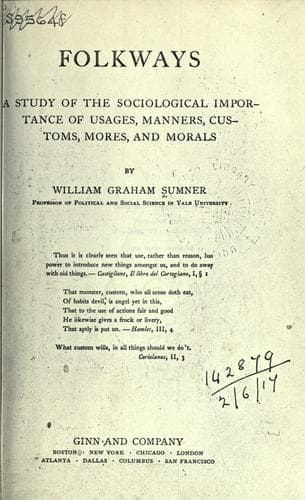
Folkways: A Study of the Sociological Importance of Usages, Manners, Customs, Mores, and MoralsSumner, William Graham
General
Folkways: A Study of the Sociological Importance of Usages, Manners, Customs, Mores, and Morals
Sumner, William Graham
Manners and customs
from current usage, and the conventionalization, while granting
toleration, defines it also, and makes a new law for the exceptional
case. It is like taboo, and is, in fact, the form of taboo in high
civilization. Like taboo, it has two aspects,--it is either destructive
or protective. The conventionalization bars out what might be offensive
(i.e. when a thing may be done only under the conditions set by
conventionalization), or it secures toleration for what would otherwise
be forbidden. Respect, reverence, sacredness, and holiness, which are
taboos in low civilization, become conventionalities in high
civilization.
+75. Conventions indispensable.+ Conventionality is often denounced as
untrue and hypocritical. It is said that we ought to be natural.
Respectability is often sneered at because it is a sum of
conventionalities. The conventionalizations which persist are the
resultant of experiments and experience as to the devices by which to
soften and smoothen the details of life. They are indispensable. We
might as well renounce clothes as to try to abolish them.
+76. The ethos or group character.+ All that has been said in this
chapter about the folkways and the mores leads up to the idea of the
group character which the Greeks called the ethos, that is, the totality
of characteristic traits by which a group is individualized and
differentiated from others. The great nations of southeastern Asia were
long removed from familiar contact with the rest of mankind and
isolated from each other, while they were each subjected to the
discipline and invariable rule of traditional folkways which covered all
social interests except the interferences of a central political
authority, which perpetrated tyranny in its own interest. The
consequence has been that Japan, China, and India have each been molded
into a firm, stable, and well-defined unit group, having a character
strongly marked both actively and passively. The governing classes of
Japan have, within fifty years, voluntarily abandoned their traditional
mores, and have adopted those of the Occident, while it does not appear
that they have lost their inherited ethos. The case stands alone in
history and is a cause of amazement. In the war with Russia, in 1904,
this people showed what a group is capable of when it has a strong
ethos. They understand each other; they act as one man; they are capable
of discipline to the death. Our western tacticians have had rules for
the percentage of loss which troops would endure, standing under fire,
before breaking and running. The rule failed for the Japanese. They
stood to the last man. Their prowess at Port Arthur against the
strongest fortifications, and on the battlefields of Manchuria,
surpassed all record. They showed what can be done in the way of
concealing military and naval movements when every soul in the
population is in a voluntary conspiracy not to reveal anything. These
traits belong to a people which has been trained by generations of
Public-domain text, read in full here on John Shaqi.
Reviews
Reviews
No reviews yet
Be the first to share your thoughts on this work.
Elsewhere in the archive
Join the Discussion
Join the discussion
Sign in to leave a comment or review.
Sign InorCreate an account