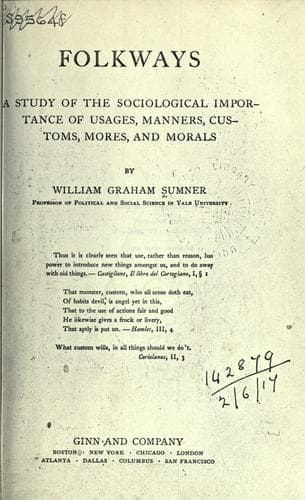
Folkways: A Study of the Sociological Importance of Usages, Manners, Customs, Mores, and MoralsSumner, William Graham
General
Folkways: A Study of the Sociological Importance of Usages, Manners, Customs, Mores, and Morals
Sumner, William Graham
Manners and customs
invariable mores. It is apparently what the mediaeval church wanted to
introduce in Europe, but the Japanese have got it without selfish
tyranny of the ruling persons and classes. Of course, it admits of no
personal liberty, and the consequences of introducing occidental notions
of liberty into it have yet to be seen. "The blacksmith squats at his
anvil wielding a hammer such as no western smith could use without long
practice. The carpenter pulls instead of pushing his extraordinary plane
and saw. Always the left is the right side, and the right side the
wrong. Keys must be turned, to open or close a lock, in what we are
accustomed to think the wrong direction." "The swordsman, delivering his
blow with both hands, does not pull the blade towards him in the moment
of striking, but pushes it from him. He uses it indeed, as other
Asiatics do, not on the principle of the wedge, but of the saw."[82] In
family manners the Japanese are gentle. Cruelty even to animals appears
to be unknown. "One sees farmers coming to town, trudging patiently
beside their horses or oxen, aiding their dumb companions to bear the
burden, and using no whips or goads. Drivers or pullers of carts will
turn out of their way, under the most provoking circumstances, rather
than overrun a lazy dog or a stupid chicken."[83] Etiquette is refined,
elaborate, and vigorous. Politeness has been diffused through all ranks
from ancient times.[84] "The discipline of the race was self-imposed.
The people have gradually created their own social conditions."[85]
"Demeanor was [in ancient times] most elaborately and mercilessly
regulated, not merely as to obeisances, of which there were countless
grades, varying according to sex as well as class, but even in regard to
facial expression, the manner of smiling, the conduct of the breath, the
way of sitting, standing, walking, rising."[86] "With the same merciless
exactitude which prescribed rules for dress, diet, and manner of life,
all utterance was regulated both positively and negatively, but
positively much more than negatively.... Education cultivated a system
of verbal etiquette so multiform that only the training of years could
enable any one to master it. The astonishment evoked by Japanese
sumptuary laws, particularly as inflicted upon the peasantry, is
justified, less by their general character than by their implacable
minuteness,--their ferocity of detail." "That a man's house is his
castle cannot be asserted in Japan, except in the case of some high
potentate. No ordinary person can shut his door to lock out the rest of
the world. Everybody's house must be open to visitors; to close its
gates by day would be regarded as an insult to the community, sickness
affording no excuse. Only persons in very great authority have the right
of making themselves inaccessible.... By a single serious mistake a man
may find himself suddenly placed in solitary opposition to the common
Public-domain text, read in full here on John Shaqi.
Reviews
Reviews
No reviews yet
Be the first to share your thoughts on this work.
Elsewhere in the archive
Join the Discussion
Join the discussion
Sign in to leave a comment or review.
Sign InorCreate an account