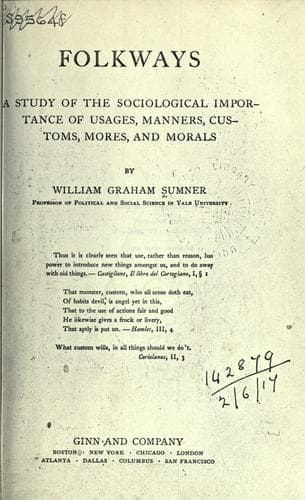
Folkways: A Study of the Sociological Importance of Usages, Manners, Customs, Mores, and MoralsSumner, William Graham
General
Folkways: A Study of the Sociological Importance of Usages, Manners, Customs, Mores, and Morals
Sumner, William Graham
Manners and customs
[21] _Bur. Eth._, XIV, 1078.
[22] Wiklund, _Om Lapparna i Sverige_, 5.
[23] Fries, _Groenland_, 139.
[24] Hiekisch, _Tungusen_, 48.
[25] Hitchcock in _U. S. Nat. Mus._, 1890, 432.
[26] Ratzel, _Hist. Mankind_, II, 539.
[27] _Bur. Eth._, XVII (Part I), 154.
[28] Von Kremer, _Kulturgesch. d. Orients_, II, 236.
[29] Bishop, _Korea_, 438.
[30] _Amer. Anthrop._, VIII, 365.
[31] Cf. also _Bur. Eth._, XVII (Part I), 190.
[32] _Une Femme chez les Sahariennes_, 105.
[33] Stoll, _Suggestion und Hypnotismus_, 702.
[34] Friedmann, _Wahnideen im Voelkerleben_, 222.
[35] Binet, _La Suggestibilite_, treats of its use in education.
[36] Lefevre, _La Suggestion_, 102.
[37] Funck-Brentano, _Le Suicide_, 117.
[38] Burckhardt, _Renaissance_, 512.
[39] Nivedita, _Web of Indian Life_, 212.
[40] Schotmueller, _Untergang des Templer-Ordens_, I, 136.
[41] Regnard, _Les Maladies Epidemiques de l'Esprit_.
[42] _Globus_, LXXXV, 262.
[43] Lefevre, _Suggestion_, 98.
[44] Bastian, _San Salvador_, 104.
[45] Ratzel, _Anthropogeog._, II, 699.
[46] Lichtenstein, _South Africa_, II, 61.
[47] Sibree, _Great African Island_, 301.
[48] _Bur. Eth._, XVIII (Part I), 325.
[49] _Ztsft. f. Eth._, XXVIII, 170.
[50] Wilken, _Volkenkunde_, 546.
[51] Sieroshevski, _Yakuty_, 558.
[52] See Chapter XIV.
[53] Ratzel, _Hist. Mankind_, II, 276.
[54] W. R. Smith, _Religion of the Semites_, 299.
[55] Herodotus, IV, 186.
[56] Porphyry, _De Abstin._, II, 11; _Herodotus_, II, 41.
[57] W. R. Smith, _Religion of the Semites_, 88.
[58] Monier-Williams, _Brahmanism and Hinduism_, 324.
[59] _Ibid._, 101.
[60] Wilkins, _Hinduism_, 299.
[61] _Ibid._, 125.
[62] JASB, IV, 353.
[63] Fritsch, _Eingeborenen Suedafr._, 57.
[64] _Bijdragen tot T. L. en V.-kunde_, XLI, 203.
[65] See Chapter XX
[66] _Hereditary Genius_, 34.
[67] Ammon, _Gesellschaftsordnung_, 53.
[68] Ammon made the diagram symmetrical.
[69] _Hereditary Genius_, 25, 47.
[70] Lapouge affirms that "in different historical periods, and
over the whole earth, racial differences between classes of the
same people are far greater than between analogous classes of
different peoples," and that "between different classes of the
same population there may be greater racial differences than
between different populations" (_Pol. Anth. Rev._, III, 220,
228). He does not give his definition of class.
[71] Ammon, _Gesellschaftsordnung_, 49.
[72] PSM, LX, 218.
[73] Lecky, _Morals_, I, 262.
[74] Symonds, _Catholic Reaction_, I, 455.
[75] Gumplowicz, _Soziologie_, 126.
[76] "In the reigns of Theodosius and Honorius, imperial edicts
and rescripts were paralyzed by the impalpable, quietly
irresistible force of a universal social need or
sentiment."--Dill, _Rome from Nero to M. Aurel._, 255.
Public-domain text, read in full here on John Shaqi.
Reviews
Reviews
No reviews yet
Be the first to share your thoughts on this work.
Elsewhere in the archive
Join the Discussion
Join the discussion
Sign in to leave a comment or review.
Sign InorCreate an account