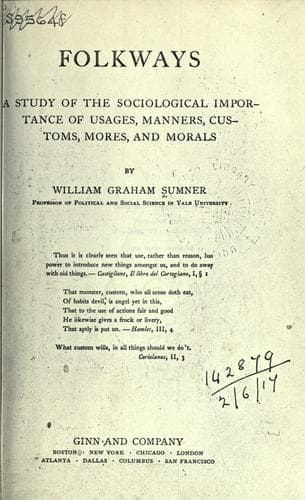
Folkways: A Study of the Sociological Importance of Usages, Manners, Customs, Mores, and MoralsSumner, William Graham
General
Folkways: A Study of the Sociological Importance of Usages, Manners, Customs, Mores, and Morals
Sumner, William Graham
Manners and customs
+79. European ethos.+ We are familiar with the notion of "national
character" as applied to the nations of Europe, but these nations do not
have each an ethos. There is a European ethos, for the nations have so
influenced each other for the last two thousand years that there is a
mixed ethos which includes local variations. The European _kharma_ is
currently called Christian. In the ancient world Egypt and Sparta were
the two cases of groups with the firmest and best-defined ethos. In
modern European history the most marked case is that of Venice. In no
one of these cases did the elements of moral strength and societal
health preponderate, but the history of each showed the great stability
produced by a strong ethos. Russia has a more complete and defined ethos
than any other state in Europe, although the efforts which have been
made since Peter the Great to break down the traditions and limitations
of the national ethos, and to adopt the ethos of western Europe, have
produced weakness and confusion. It is clear what is the great power of
a strong ethos. The ethos of any group deserves close study and
criticism. It is an overruling power for good or ill. Modern scholars
have made the mistake of attributing to _race_ much which belongs to the
ethos, with a resulting controversy as to the relative importance of
nature and nurture. Others have sought a "soul of the people" and have
tried to construct a "collective psychology," repeating for groups
processes which are now abandoned for individuals. Historians, groping
for the ethos, have tried to write the history of "the people" of such
and such a state. The ethos individualizes groups and keeps them apart.
Its opposite is cosmopolitanism. It degenerates into patriotic vanity
and chauvinism. Industrialism weakens it, by extending relations of
commerce with outside groups. It coincides better with militancy. It has
held the Japanese people like a single mailed fist for war. What
religion they have has lost all character except that of a cohesive
agent to hold the whole close organization tight together.
[1] JAI, XX, 140.
[2] Lazarus in _Ztsft. fuer Voelkerpsy_., I, 452.
[3] Preuss in _Globus_, LXXXVII, 419.
[4] _Princ. of Sociology_, sec. 529.
[5] Rogers, _Babyl. and Assyria_, I, 304; Jastrow, in
Hastings, _Dict. Bible_, Supp. vol., 554.
[6] Pietschmann, _Phoenizier_, 154.
[7] Pietschmann, _Phoenizier_, 115.
[8] Maspero, _Peuples de l'Orient_, III, 618.
[9] W. R. Smith, _Religion of the Semites_, 259.
[10] Hosea i. 4; 2 Kings ix. 8.
[11] 1 Kings xxii. 22; Judges ix. 23; Ezek. xiv. 9; 2 Thess. ii.
11.
[12] 2 Kings xx. 3.
[13] Reich, _Mimus_, 718.
[14] _Teuton. Mythol._, 1777.
[15] Leland and Prince, _Kuloskap_, 150.
[16] _Globus_, LXXXVII, 128.
[17] Martius, _Ethnog. Brasil._, 51.
[18] Krieger, _New Guinea_, 192.
[19] Tylor, _Anthropology_, 225.
[20] Martius, _Ethnog. Brasil._, 51.
Public-domain text, read in full here on John Shaqi.
Reviews
Reviews
No reviews yet
Be the first to share your thoughts on this work.
Elsewhere in the archive
Join the Discussion
Join the discussion
Sign in to leave a comment or review.
Sign InorCreate an account