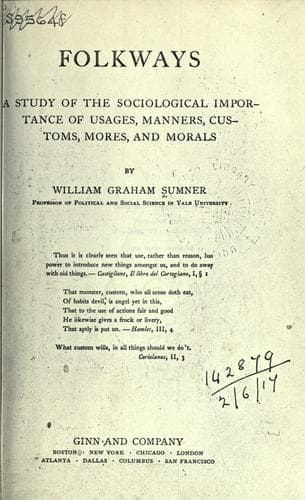
Folkways: A Study of the Sociological Importance of Usages, Manners, Customs, Mores, and MoralsSumner, William Graham
General
Folkways: A Study of the Sociological Importance of Usages, Manners, Customs, Mores, and Morals
Sumner, William Graham
Manners and customs
In this chapter we have to study the persistency of the mores with their
inertia and rigidity, even against a new religion or a new "law," i.e. a
new social system (secs. 80-87); then their variability under changed
life conditions or under revolution (secs. 88-90); then the possibility
of making them change by intelligent effort, considering the cases of
Japan, India, and the reforms of Joseph II (secs. 91-97); or the
possibility of changing one's self to adopt the mores of another group
or another age (secs. 98-99). We shall then consider the dissent of an
individual or a sect from the current mores, with judgment of
disapproval on them (secs. 100-104), and the chance of correcting them
(sec. 105). Next we shall consider the great movements of the mores,
optimism and pessimism, which correspond to a rising or falling economic
conjuncture (secs. 106-111). Then come the antagonisms between an
individual and the mores, between the mores of an earlier and a later
time, and between the groups in respect to mores, with a notice of the
problem of missions (secs. 112-118). Finally, we come to consider
agitation to produce changes in the mores, and we endeavor to study the
ways in which the changes in the mores do come about, especially
syncretism (secs. 119-121).
+80. The mores have the authority of facts.+ The mores come down to us
from the past. Each individual is born into them as he is born into the
atmosphere, and he does not reflect on them, or criticise them any more
than a baby analyzes the atmosphere before he begins to breathe it. Each
one is subjected to the influence of the mores, and formed by them,
before he is capable of reasoning about them. It may be objected that
nowadays, at least, we criticise all traditions, and accept none just
because they are handed down to us. If we take up cases of things which
are still entirely or almost entirely in the mores, we shall see that
this is not so. There are sects of free-lovers amongst us who want to
discuss pair marriage (sec. 374). They are not simply people of evil
life. They invite us to discuss rationally our inherited customs and
ideas as to marriage, which, they say, are by no means so excellent and
elevated as we believe. They have never won any serious attention. Some
others want to argue in favor of polygamy on grounds of expediency. They
fail to obtain a hearing. Others want to discuss property. In spite of
some literary activity on their part, no discussion of property,
bequest, and inheritance has ever been opened. Property and marriage are
in the mores. Nothing can ever change them but the unconscious and
imperceptible movement of the mores. Religion was originally a matter of
the mores. It became a societal institution and a function of the state.
It has now to a great extent been put back into the mores. Since laws
with penalties to enforce religious creeds or practices have gone out of
use any one may think and act as he pleases about religion. Therefore it
Public-domain text, read in full here on John Shaqi.
Reviews
Reviews
No reviews yet
Be the first to share your thoughts on this work.
Elsewhere in the archive
Join the Discussion
Join the discussion
Sign in to leave a comment or review.
Sign InorCreate an account