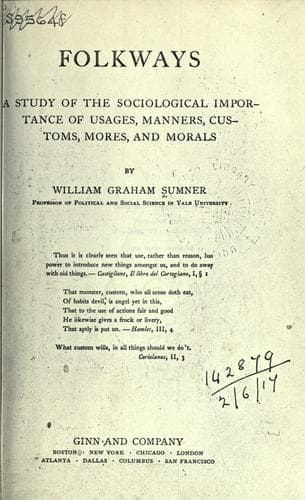
Folkways: A Study of the Sociological Importance of Usages, Manners, Customs, Mores, and MoralsSumner, William Graham
General
Folkways: A Study of the Sociological Importance of Usages, Manners, Customs, Mores, and Morals
Sumner, William Graham
Manners and customs
is not now "good form" to attack religion. Infidel publications are now
tabooed by the mores, and are more effectually repressed than ever
before. They produce no controversy. Democracy is in our American mores.
It is a product of our physical and economic conditions. It is
impossible to discuss or criticise it. It is glorified for popularity,
and is a subject of dithyrambic rhetoric. No one treats it with complete
candor and sincerity. No one dares to analyze it as he would aristocracy
or autocracy. He would get no hearing and would only incur abuse. The
thing to be noticed in all these cases is that the masses oppose a deaf
ear to every argument against the mores. It is only in so far as things
have been transferred from the mores into laws and positive institutions
that there is discussion about them or rationalizing upon them. The
mores contain the norm by which, if we should discuss the mores, we
should have to judge the mores. We learn the mores as unconsciously as
we learn to walk and eat and breathe. The masses never learn how we
walk, and eat, and breathe, and they never know any reason why the mores
are what they are. The justification of them is that when we wake to
consciousness of life we find them facts which already hold us in the
bonds of tradition, custom, and habit. The mores contain embodied in
them notions, doctrines, and maxims, but they are facts. They are in the
present tense. They have nothing to do with what ought to be, will be,
may be, or once was, if it is not now.
Public-domain text, read in full here on John Shaqi.
Reviews
Reviews
No reviews yet
Be the first to share your thoughts on this work.
Elsewhere in the archive
Join the Discussion
Join the discussion
Sign in to leave a comment or review.
Sign InorCreate an account