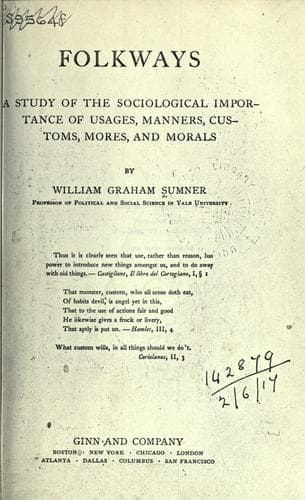
Folkways: A Study of the Sociological Importance of Usages, Manners, Customs, Mores, and MoralsSumner, William Graham
General
Folkways: A Study of the Sociological Importance of Usages, Manners, Customs, Mores, and Morals
Sumner, William Graham
Manners and customs
+81. Blacks and whites in southern society.+ In our southern states,
before the civil war, whites and blacks had formed habits of action and
feeling towards each other. They lived in peace and concord, and each
one grew up in the ways which were traditional and customary. The civil
war abolished legal rights and left the two races to learn how to live
together under other relations than before. The whites have never been
converted from the old mores. Those who still survive look back with
regret and affection to the old social usages and customary sentiments
and feelings. The two races have not yet made new mores. Vain attempts
have been made to control the new order by legislation. The only result
is the proof that legislation cannot make mores. We see also that mores
do not form under social convulsion and discord. It is only just now
that the new society seems to be taking shape. There is a trend in the
mores now as they begin to form under the new state of things. It is not
at all what the humanitarians hoped and expected. The two races are
separating more than ever before. The strongest point in the new code
seems to be that any white man is boycotted and despised if he
"associates with negroes" (sec. 114, at the end). Some are anxious to
interfere and try to control. They take their stand on ethical views of
what is going on. It is evidently impossible for any one to interfere.
We are like spectators at a great natural convulsion. The results will
be such as the facts and forces call for. We cannot foresee them. They
do not depend on ethical views any more than the volcanic eruption on
Martinique contained an ethical element. All the faiths, hopes,
energies, and sacrifices of both whites and blacks are components in the
new construction of folkways by which the two races will learn how to
live together. As we go along with the constructive process it is very
plain that what once was, or what any one thinks ought to be, but
slightly affects what, at any moment, is. The mores which once were are
a memory. Those which any one thinks ought to be are a dream. The only
thing with which we can deal are those which are.
Public-domain text, read in full here on John Shaqi.
Reviews
Reviews
No reviews yet
Be the first to share your thoughts on this work.
Elsewhere in the archive
Join the Discussion
Join the discussion
Sign in to leave a comment or review.
Sign InorCreate an account