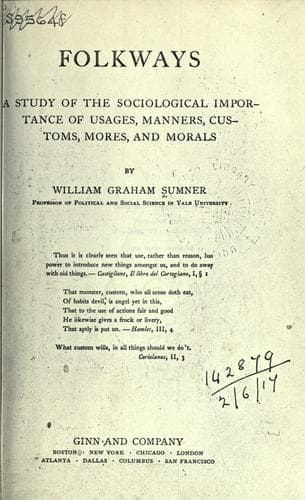
Folkways: A Study of the Sociological Importance of Usages, Manners, Customs, Mores, and MoralsSumner, William Graham
General
Folkways: A Study of the Sociological Importance of Usages, Manners, Customs, Mores, and Morals
Sumner, William Graham
Manners and customs
+83. Inertia and rigidity of the mores.+ We see that we must conceive of
the mores as a vast system of usages, covering the whole of life, and
serving all its interests; also containing in themselves their own
justification by tradition and use and wont, and approved by mystic
sanctions until, by rational reflection, they develop their own
philosophical and ethical generalizations, which are elevated into
"principles" of truth and right. They coerce and restrict the newborn
generation. They do not stimulate to thought, but the contrary. The
thinking is already done and is embodied in the mores. They never
contain any provision for their own amendment. They are not questions,
but answers, to the problem of life. They present themselves as final
and unchangeable, because they present answers which are offered as "the
truth." No world philosophy, until the modern scientific world
philosophy, and that only within a generation or two, has ever presented
itself as perhaps transitory, certainly incomplete, and liable to be set
aside to-morrow by more knowledge. No popular world philosophy or life
policy ever can present itself in that light. It would cost too great a
mental strain. All the groups whose mores we consider far inferior to
our own are quite as well satisfied with theirs as we are with ours. The
goodness or badness of mores consists entirely in their adjustment to
the life conditions and the interests of the time and place (sec. 65).
Therefore it is a sign of ease and welfare when no thought is given to
the mores, but all cooperate in them instinctively. The nations of
southeastern Asia show us the persistency of the mores, when the
element of stability and rigidity in them becomes predominant. Ghost
fear and ancestor worship tend to establish the persistency of the mores
by dogmatic authority, strict taboo, and weighty sanctions. The mores
then lose their naturalness and vitality. They are stereotyped. They
lose all relation to expediency. They become an end in themselves. They
are imposed by imperative authority without regard to interests or
conditions (caste, child marriage, widows). When any society falls under
the dominion of this disease in the mores it must disintegrate before it
can live again. In that diseased state of the mores all learning
consists in committing to memory the words of the sages of the past who
established the formulae of the mores. Such words are "sacred writings,"
a sentence of which is a rule of conduct to be obeyed quite
independently of present interests, or of any rational considerations.
Public-domain text, read in full here on John Shaqi.
Reviews
Reviews
No reviews yet
Be the first to share your thoughts on this work.
Elsewhere in the archive
Join the Discussion
Join the discussion
Sign in to leave a comment or review.
Sign InorCreate an account