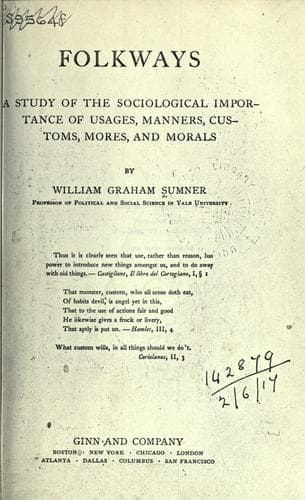
Folkways: A Study of the Sociological Importance of Usages, Manners, Customs, Mores, and MoralsSumner, William Graham
General
Folkways: A Study of the Sociological Importance of Usages, Manners, Customs, Mores, and Morals
Sumner, William Graham
Manners and customs
+84. Persistency.+ Asiatic fixity of the mores is extreme, but the
element of persistency in the mores is always characteristic of them.
They are elastic and tough, but when once established in familiar and
continued use they resist change. They give stability to the social
order when they are well understood, regular, and undisputed. In a new
colony, with a sparse population, the mores are never fixed and
stringent. There is great "liberty." As the colony always has traditions
of the mores of the mother country, which are cherished with respect but
are never applicable to the conditions of a colony, the mores of a
colony are heterogeneous and are always in flux. That is because the
colonists are all the time learning to live in a new country and have no
traditions to guide them, the traditions of the old country being a
hindrance. Any one bred in a new country, if he goes to an old country,
feels the "conservatism" in its mores. He thinks the people stiff, set
in their ways, stupid, and unwilling to learn. They think him raw,
brusque, and uncultivated. He does not know the ritual, which can be
written in no books, but knowledge of which, acquired by long
experience, is the mark of fit membership in the society.
+85. Persistency in spite of change of religion.+ Matthews saw votive
effigies in Mandan villages just like those which Catlin had seen and
put into his pictures seventy years before.[90] In the meantime the
Mandans had been nearly exterminated by war and disease, and the remnant
of them had been civilized and Christianized. The mores of the Central
American Indians inculcate moderation and restraint. Their ancient
religion contained prescriptions of that character, and those
prescriptions are still followed after centuries of life under
Christianity.[91] In the Bible we may see the strife between old mores
and a new religious system two or three times repeated. The so-called
Mosaic system superseded an older system of mores common, as it appears,
to all the Semites of western Asia. The prophets preached a reform of
the Jahveh religion and we find them at war with the inherited
mores.[92] The most striking feature of the story of the prophets is
their antagonism to the mores which the people would not give up.
Monotheism was not established until after the captivity.[93] The
recurrence, vitality, popularity, and pervasiveness of traditional mores
are well shown in the Bible story. The result was a combination of
ritual monotheism with survivals of ancient mores and a popular religion
in which demonism was one of the predominant elements. The New Testament
represents a new revival and reform of the religion. The Jews to this
day show the persistency of ancient mores. Christianity was a new
adjustment of both heathen and Jewish mores to a new religious system.
The popular religion once more turned out to be a grand revival of
demonism. The masses retained their mores with little change. The mores
overruled the religion.
Public-domain text, read in full here on John Shaqi.
Reviews
Reviews
No reviews yet
Be the first to share your thoughts on this work.
Elsewhere in the archive
Join the Discussion
Join the discussion
Sign in to leave a comment or review.
Sign InorCreate an account