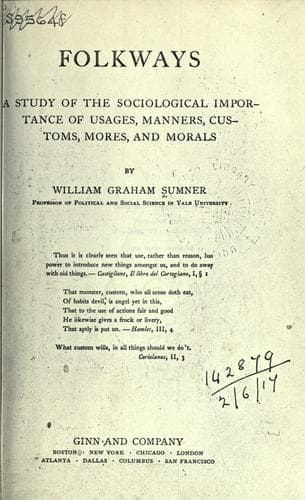
Folkways: A Study of the Sociological Importance of Usages, Manners, Customs, Mores, and MoralsSumner, William Graham
General
Folkways: A Study of the Sociological Importance of Usages, Manners, Customs, Mores, and Morals
Sumner, William Graham
Manners and customs
+86. Roman law.+ In the Roman law everything proceeds from the emperor.
He is the possessor of all authority, the fountain of honor, the author
of all legislation, and the referee in all disputes. Lawyers trained by
the study of this code learned to conceive of all the functions of the
state as acts, powers, and rights of a monarchical sovereign. They stood
beside the kings and princes of the later Middle Ages ready to construe
the institutions of suzerainty into this monarchical form. They broke
down feudalism and helped to build the absolutist dynastic state,
wherever the Roman law was in force, and wherever it had greatly
influenced the legal system. The church also had great interest to
employ the Roman law, because it included the ecclesiastical legislation
of the Christian emperors of the fourth and fifth centuries, and because
the canon law was imitated from it in spirit and form. In all matters of
private rights the provisions of the Justinian code were good and
beneficial, so that those provisions won their own way by their own
merit.[98] In the _Sachsenspiegel_ there was no distinction of property
between man and wife, but this meant that all which both had was a
joint capital for use in their domestic economy. When the marriage was
dissolved the property returned to the side from which it came. Later,
in many districts, this arrangement developed into a real community of
goods under various forms. "It was in regard to these adjustments of
property rights that the jurists of the Middle Ages did most harm by
introducing the Roman law, for it was especially in regard to this
matter that the Roman law stood in strongest contrast to the German
notions, and the resistance of the German people is to be seen in the
numerous local systems of law, which remained in use in most of Germany;
unfortunately not everywhere, nor uniformly."[99]
Public-domain text, read in full here on John Shaqi.
Reviews
Reviews
No reviews yet
Be the first to share your thoughts on this work.
Elsewhere in the archive
Join the Discussion
Join the discussion
Sign in to leave a comment or review.
Sign InorCreate an account