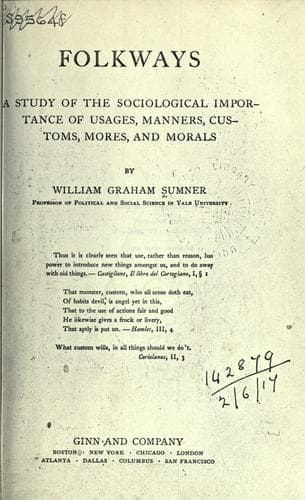
Folkways: A Study of the Sociological Importance of Usages, Manners, Customs, Mores, and MoralsSumner, William Graham
General
Folkways: A Study of the Sociological Importance of Usages, Manners, Customs, Mores, and Morals
Sumner, William Graham
Manners and customs
+87. The Roman law: its effect on later mores.+ Throughout the
north of Europe, upon conversion to Christianity, tithes were the
stumbling-block between the old mores and the new system.[100]
The authority for the tithe system came from the Roman system. It
was included in the Roman jurisprudence which the church adopted
and carried wherever it extended. After the civil code was
revived it helped powerfully to make states. This was a work,
however, which was hostile to the church. The royal lawyers found
in the civil code a system which referred everything in society
to the emperor as the origin of power, rights, and honor. They
adopted this standpoint for the kings of the new dynastic states
and, in the might of the Roman law, they established royal
absolutism, which was unfavorable to the church and the feudal
nobles. They found their allies in the cities which loved written
law, institutions, and defined powers. Stubbs[101] regards the
form of the Statute of Westminster (1275) as a proof that the
lawyers, who "were at this time getting a firm grasp on the law
of England," were introducing the principle that the king could
enact by his own authority. The spirit of the Roman law was
pitiless to peasants and artisans, that is, to all who were, or
were to be made, unfree. The Norman laws depressed the Saxon
ceorl to a slave.[102] In similar manner they came into war with
all Teutonic mores which contained popular rights and primary
freedom. Stammler[103] denies that the Roman law, in spite of
lawyers and ecclesiastics, ever entered into the flesh and blood
of the German people. That is to say, it never displaced
completely their national mores. The case of the property of
married persons is offered as a case in which the German mores
were never overcome.[104] A compromise was struck between the
ancient mores and the new ways, which the Roman Catholic religion
approved.
Public-domain text, read in full here on John Shaqi.
Reviews
Reviews
No reviews yet
Be the first to share your thoughts on this work.
Elsewhere in the archive
Join the Discussion
Join the discussion
Sign in to leave a comment or review.
Sign InorCreate an account