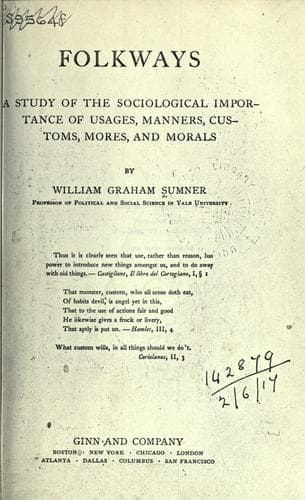
Folkways: A Study of the Sociological Importance of Usages, Manners, Customs, Mores, and MoralsSumner, William Graham
General
Folkways: A Study of the Sociological Importance of Usages, Manners, Customs, Mores, and Morals
Sumner, William Graham
Manners and customs
+88. Variability.+ No less remarkable than the persistency of the mores
is their changeableness and variation. There is here an interesting
parallel to heredity and variation in the organic world, even though the
parallel has no significance. Variation in the mores is due to the fact
that children do not perpetuate the mores just as they received them.
The father dies, and the son whom he has educated, even if he continues
the ritual and repeats the formulae, does not think and feel the same
ideas and sentiments as his father. The observance of Sunday; the mode
of treating parents, children, servants, and wives or husbands;
holidays; amusements; arts of luxury; marriage and divorce; wine
drinking,--are matters in regard to which it is easy to note changes in
the mores from generation to generation, in our own times. Even in Asia,
when a long period of time is taken into account, changes in the mores
are perceptible. The mores change because conditions and interests
change. It is found that dogmas and maxims which have been current do
not verify; that established taboos are useless or mischievous
restraints; that usages which are suitable for a village or a colony are
not suitable for a great city or state; that many things are fitting
when the community is rich which were not so when it was poor; that new
inventions have made new ways of living more economical and healthful.
It is necessary to prosperity that the mores should have a due degree of
firmness, but also that they should be sufficiently elastic and flexible
to conform to changes in interests and life conditions. A herding or an
agricultural people, if it moves into a new country, rich in game, may
revert to a hunting life. The Tunguses and Yakuts did so as they moved
northwards.[105] In the early days of the settlement of North America
many whites "Indianized"; they took to the mode of life of Indians. The
Iranians separated from the Indians of Hindostan and became
agriculturists. They adopted a new religion and new mores. Men who were
afraid of powerful enemies have taken to living in trees, lake
dwellings, caves, and joint houses. Mediaeval serfdom was due to the need
of force to keep the peasant on his holding, when the holding was really
a burden to him in view of the dues which he must pay. He would have run
away if he had not been kept by force. In the later Middle Ages the
villain had a valuable right and property in his holding. Then he wanted
security of tenure so that he could not be driven away from it. In the
early period it was the duty of the lord to kill the game and protect
the peasant's crops. In the later period it became the monopoly right of
the lord to kill game. Thus the life conditions vary. The economic
conjuncture varies. The competition of life varies. The interests vary
with them. The mores all conform, unless they have been fixed by dogma
with mystic sanctions so that they are ritual obligations, as is, in
general, the case now in southeastern Asia.
Public-domain text, read in full here on John Shaqi.
Reviews
Reviews
No reviews yet
Be the first to share your thoughts on this work.
Elsewhere in the archive
Join the Discussion
Join the discussion
Sign in to leave a comment or review.
Sign InorCreate an account