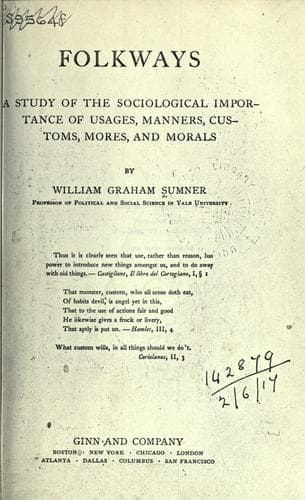
Folkways: A Study of the Sociological Importance of Usages, Manners, Customs, Mores, and MoralsSumner, William Graham
General
Folkways: A Study of the Sociological Importance of Usages, Manners, Customs, Mores, and Morals
Sumner, William Graham
Manners and customs
+90. Revolution.+ In higher civilization crises produced by the
persistency of old mores after conditions have changed are solved by
revolution or reform. In revolutions the mores are broken up. Such was
the case in the sixteenth century, in the French Revolution of 1789, and
in minor revolutions. A period follows the outburst of a revolution in
which there are no mores. The old are broken up; the new are not formed.
The social ritual is interrupted. The old taboos are suspended. New
taboos cannot be enacted or promulgated. They require time to become
established and known. The masses in a revolution are uncertain what
they ought to do. In France, under the old regime, the social ritual was
very complete and thoroughly established. In the revolution, the
destruction of this ritual produced social anarchy. In the best case
every revolution must be attended by this temporary chaos of the mores.
It was produced in the American colonies. Revolutionary leaders expect
to carry the people over to new mores by the might of two or three
dogmas of political or social philosophy. The history of every such
attempt shows that dogmas do not make mores. Every revolution suffers a
collapse at the point where reconstruction should begin. Then the old
ruling classes resume control, and by the use of force set the society
in its old grooves again. The ecclesiastical revolution of the sixteenth
century resulted in a wreck whose discordant fragments we have
inherited. It left us a Christendom, half of which is obscurantist and
half scientific; half is ruled by the Jesuits and half is split up into
wrangling sects. The English Revolution of the seventeenth century was
reversed when it undertook to reconstruct the mores of the English
people. The French revolutionists tried to abolish all the old mores and
to replace them by products of speculative philosophy. The revolution
was, in fact, due to a great change in conditions, which called for new
mores, and so far as the innovations met this demand they became
permanent and helped to create a conviction of the beneficence of
revolution. Napoleon abolished many innovations and put many things in
the old train again. Many other things have changed name and face, but
not character. Many innovations have been half assimilated. Some
interests have never yet been provided for (see sec. 165).
Public-domain text, read in full here on John Shaqi.
Reviews
Reviews
No reviews yet
Be the first to share your thoughts on this work.
Elsewhere in the archive
Join the Discussion
Join the discussion
Sign in to leave a comment or review.
Sign InorCreate an account