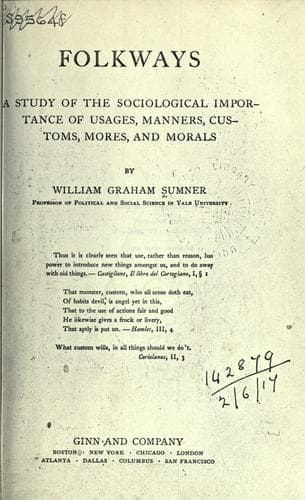
Folkways: A Study of the Sociological Importance of Usages, Manners, Customs, Mores, and MoralsSumner, William Graham
General
Folkways: A Study of the Sociological Importance of Usages, Manners, Customs, Mores, and Morals
Sumner, William Graham
Manners and customs
+91. Possibility of modifying mores.+ The combination in the mores of
persistency and variability determines the extent to which it is
possible to modify them by arbitrary action. It is not possible to
change them, by any artifice or device, to a great extent, or suddenly,
or in any essential element; it is possible to modify them by slow and
long-continued effort if the ritual is changed by minute variations. The
German emperor Frederick II was the most enlightened ruler of the Middle
Ages. He was a modern man in temper and ideas. He was a statesman and he
wanted to make the empire into a real state of the absolutist type. All
the mores of his time were ecclesiastical and hierocratic. He dashed
himself to pieces against them. Those whom he wanted to serve took the
side of the papacy against him. He became the author of the laws by
which the civil institutions of the time were made to serve
ecclesiastical domination. He carried the purpose of the crusades to a
higher degree of fulfillment than they ever reached otherwise, but this
brought him no credit or peace. The same drift in the mores of the time
bore down the Albigenses when they denounced the church corporation, the
hierarchy, and the papacy. The pope easily stirred up all Europe against
them. The current opinion was that every state must be a Christian state
according to the mores of the time. The people could not conceive of a
state which could answer its purpose if it was not such. But a
"Christian state" meant one which was in harmony with the pope and the
ecclesiastical organization. This demand was not affected by the faults
of the organization, or the corruption and venality of the hierarchy.
The popes of the thirteenth century rode upon this tide, overwhelming
opposition and consolidating their power. In our time the state is
charged with the service of a great number of interests which were then
intrusted to the church. It is against our mores that ecclesiastics
should interfere with those interests. There is no war on religion.
Religion is recognized as an interest by itself, and is treated with
more universal respect than ever before, but it is regarded as occupying
a field of its own, and if there should be an attempt in its name to
encroach on any other domain, it would fail, because it would be against
the mores of our time.
Public-domain text, read in full here on John Shaqi.
Reviews
Reviews
No reviews yet
Be the first to share your thoughts on this work.
Elsewhere in the archive
Join the Discussion
Join the discussion
Sign in to leave a comment or review.
Sign InorCreate an account