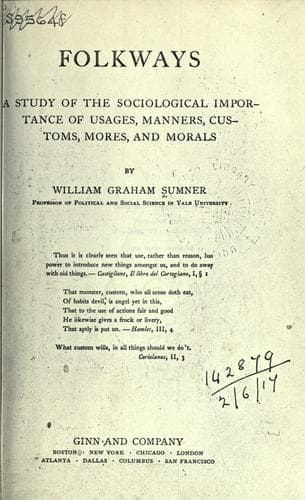
Folkways: A Study of the Sociological Importance of Usages, Manners, Customs, Mores, and MoralsSumner, William Graham
General
Folkways: A Study of the Sociological Importance of Usages, Manners, Customs, Mores, and Morals
Sumner, William Graham
Manners and customs
+93. Emancipation in Russia and the United States.+ In the time of Peter
the Great the ancient national mores of Russia were very strong and
firmly established. They remain to this day, in the mass of the
population, unchanged in their essential integrity. There is, amongst
the upper classes, an imitation of French ways, but it is unimportant
for the nation. The autocracy is what makes "Russia," as a political
unit. The autocracy is the apex of a military system, by which a great
territory has been gathered under one control. That operation has not
affected the old mores of the people. The tsar Alexander II was
convinced by reading the writings of the great literary coterie of the
middle of the nineteenth century that serfdom ought to be abolished, and
he determined that it should be done.[106] It is not in the system of
autocracy that the autocrat shall have original opinions and adopt an
independent initiative. The men whom he ordered to abolish serfdom had
to devise a method, and they devised one which was to appear
satisfactory to the tsar, but was to protect the interests which they
cared for. One is reminded of the devices of American politicians to
satisfy the clamor of the moment, but to change nothing. The reform had
but slight root in public opinion, and no sanction in the interests of
the influential classes; quite the contrary. The consequence is that the
abolition of serfdom has thrown Russian society into chaos, and as yet
reconstruction upon the new system has made little growth. In the United
States the abolition of slavery was accomplished by the North, which had
no slaves and enforced emancipation by war on the South, which had them.
The mores of the South were those of slavery in full and satisfactory
operation, including social, religious, and philosophical notions
adapted to slavery. The abolition of slavery in the northern states had
been brought about by changes in conditions and interests. Emancipation
in the South was produced by outside force against the mores of the
whites there. The consequence has been forty years of economic, social,
and political discord. In this case free institutions and mores in which
free individual initiative is a leading element allow efforts towards
social readjustment out of which a solution of the difficulties will
come. New mores will be developed which will cover the situation with
customs, habits, mutual concessions, and cooperation of interests, and
these will produce a social philosophy consistent with the facts. The
process is long, painful, and discouraging, but it contains its own
guarantees.
Public-domain text, read in full here on John Shaqi.
Reviews
Reviews
No reviews yet
Be the first to share your thoughts on this work.
Elsewhere in the archive
Join the Discussion
Join the discussion
Sign in to leave a comment or review.
Sign InorCreate an account