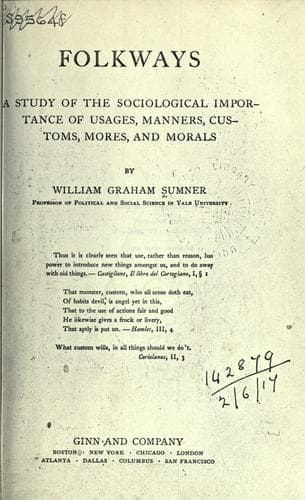
Folkways: A Study of the Sociological Importance of Usages, Manners, Customs, Mores, and MoralsSumner, William Graham
General
Folkways: A Study of the Sociological Importance of Usages, Manners, Customs, Mores, and Morals
Sumner, William Graham
Manners and customs
+94. Arbitrary change.+ We often meet with references to Abraham Lincoln
and Alexander II as political heroes who set free millions of slaves or
serfs "by a stroke of the pen." Such references are only flights of
rhetoric. They entirely miss the apprehension of what it is to set men
free, or to tear out of a society mores of long growth and wide reach.
Circumstances may be such that a change which is imperative can be
accomplished in no other way, but then the period of disorder and
confusion is unavoidable. The stroke of the pen never does anything but
order that this period shall begin.
+95. Case of Japan.+ Japan offers a case of the voluntary resolution of
the ruling class of a nation to abandon their mores and adopt those of
other nations. The case is unique in history. Humbert says that the
Japanese were in the first throes of internal revolution when
foreigners intervened.[107] Schallmeyer infers that the "adaptability of
an intelligent and disciplined people is far greater than we, judging
from other cases, have been wont to believe."[108] Le Bon absolutely
denies that culture can be transmitted from people to people. He says
that the ruin of Japan is yet to come, from the attempt to adopt foreign
ways.[109] The best information is that the mores of the Japanese masses
have not been touched. The changes are all superficial with respect to
the life of the people and their character.[110] "Iyeyasu was careful to
qualify the meaning of 'rude.' He said that the Japanese term for a rude
fellow signified 'an other-than-expected person'--so that to commit an
offense worthy of death it was only necessary to act in an 'unexpected
manner,' that is to say, contrary to prescribed etiquette."[111] "Even
now the only safe rule of conduct in a Japanese settlement is to act in
all things according to local custom; for the slightest divergence from
rule will be observed with disfavor. Privacy does not exist; nothing can
be hidden; everybody's vices or virtues are known to everybody else.
Unusual behavior is judged as a departure from the traditional standard
of conduct; all oddities are condemned as departures from custom, and
tradition and custom still have the force of religious obligations.
Indeed, they really _are_ religious and obligatory, not only by reason
of their origin, but by reason of their relation also to the public
cult, which signifies the worship of the past. The ethics of Shinto were
all included in conformity to custom. The traditional rules of the
commune--these were the morals of Shinto: to obey them was religion; to
disobey them impiety."[112] Evidently this is a description of a society
in which tradition and current usage exert complete control. It is idle
to imagine that the masses of an oriental society of that kind could, in
a thousand years, assimilate the mores of the Occident.
Public-domain text, read in full here on John Shaqi.
Reviews
Reviews
No reviews yet
Be the first to share your thoughts on this work.
Elsewhere in the archive
Join the Discussion
Join the discussion
Sign in to leave a comment or review.
Sign InorCreate an account