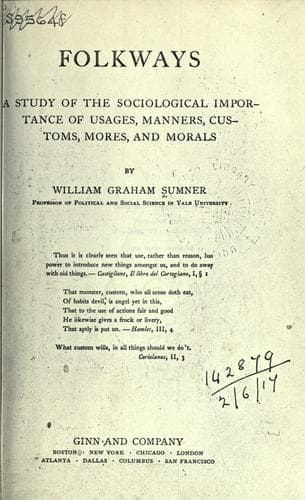
Folkways: A Study of the Sociological Importance of Usages, Manners, Customs, Mores, and MoralsSumner, William Graham
General
Folkways: A Study of the Sociological Importance of Usages, Manners, Customs, Mores, and Morals
Sumner, William Graham
Manners and customs
only to a very limited extent.
+99. What changes are possible.+ All these cases go to show that changes
which run with the mores are easily brought about, but that changes
which are opposed to the mores require long and patient effort, if they
are possible at all. The ruling clique can use force to warp the mores
towards some result which they have selected, especially if they bring
their effort to bear on the ritual, not on the dogmas, and if they are
contented to go slowly. The church has won great results in this way,
and by so doing has created a belief that religion, or ideas, or
institutions, make mores. The leading classes, no matter by what
standard they are selected, can lead by example, which always affects
ritual. An aristocracy acts in this way. It suggests standards of
elegance, refinement, and nobility, and the usages of good manners,
from generation to generation, are such as have spread from the
aristocracy to other classes. Such influences are unspoken, unconscious,
unintentional. If we admit that it is possible and right for some to
undertake to mold the mores of others, of set purpose, we see that the
limits within which any such effort can succeed are very narrow, and the
methods by which it can operate are strictly defined. The favorite
methods of our time are legislation and preaching. These methods fail
because they do not affect ritual, and because they always aim at great
results in a short time. Above all, we can judge of the amount of
serious attention which is due to plans for "reorganizing society," to
get rid of alleged errors and inconveniences in it. We might as well
plan to reorganize our globe by redistributing the elements in it.
Public-domain text, read in full here on John Shaqi.
Reviews
Reviews
No reviews yet
Be the first to share your thoughts on this work.
Elsewhere in the archive
Join the Discussion
Join the discussion
Sign in to leave a comment or review.
Sign InorCreate an account