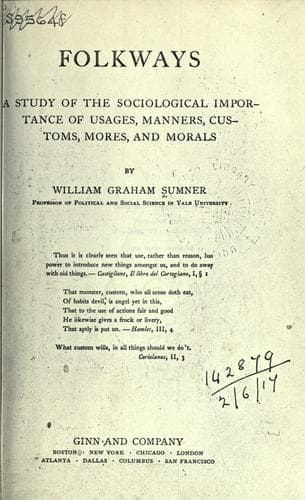
Folkways: A Study of the Sociological Importance of Usages, Manners, Customs, Mores, and MoralsSumner, William Graham
General
Folkways: A Study of the Sociological Importance of Usages, Manners, Customs, Mores, and Morals
Sumner, William Graham
Manners and customs
Frederick of Prussia said that
Joseph always took the second step without having taken the first. In
the end the emperor revoked all his changes and innovations except the
abolition of serfdom and religious toleration.[115] Some of his measures
were gradually realized through the nineteenth century. Others are now
an object of political effort.
+98. Adoption of mores of another age.+ The Renaissance was a period in
which an attempt was made by one age to adopt the mores of another, as
the latter were known through literature and art. The knowledge was very
imperfect and mistaken, as indeed it necessarily must be, and the
conceptions which were formed of the model were almost as fantastic as
if they had been pure creations of the imagination. The learning of the
Renaissance was necessarily restricted to the selected classes, and the
masses either remained untouched by the faiths and fads of the learned,
or accepted the same in grotesquely distorted forms. A phrase of a
classical writer, or a fanciful conception of some hero of Plutarch,
sufficed to enthuse a criminal, or to upset the mental equilibrium of a
political speculator. The jumble of heterogeneous mores, and of ideas
conformable to different mores, caused numbers to lose their mental
equilibrium and to become victims either of enthusiasm or of
melancholy.[116] The phenomena of suggestion were astounding and
incalculable.[117] The period was marked by the dominion of dogmatic
ideas, accepted as regulative principles for the mores. The result was
the dominion of the phrase and the prevalence of hollow affectation. The
men who were most thoroughly interested in the new learning, and had
lost faith in the church and the religion of the Middle Ages, kept up
the ritual of the traditional system. The Renaissance never made any new
ritual. That is why it had no strong root and passed away as a temporary
fashion. Hearn[118] is led from his study of Japan to say that "We could
no more mingle with the old Greek life, if it were resurrected for us,
no more become a part of it, than we could change our mental
identities." The modern classicists have tried to resuscitate Greek
standards, faiths, and ways. Individuals have met with a measure of
success in themselves, and university graduates have to some extent
reached common views of life and well living, but they have necessarily
selected what features they would imitate, and so they have arbitrarily
overruled their chosen authority. They have never won wide respect for
it in modern society. The New England Puritans, in the seventeenth
century, tried to build a society on the Bible, especially the books of
Moses. The attempt was in every way a failure. It may well be doubted if
any society ever existed of which the books referred to were a
description, and the prescriptions were found ill adapted to
seventeenth-century facts. The mores made by any age for itself are good
and right for that age, but it follows that they can suit another age
Public-domain text, read in full here on John Shaqi.
Reviews
Reviews
No reviews yet
Be the first to share your thoughts on this work.
Elsewhere in the archive
Join the Discussion
Join the discussion
Sign in to leave a comment or review.
Sign InorCreate an account