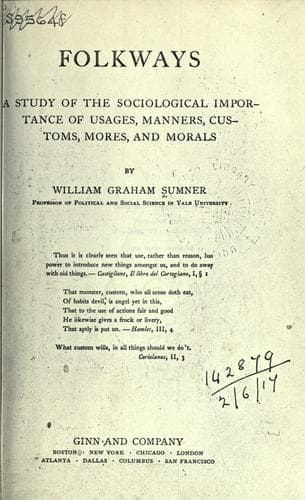
Folkways: A Study of the Sociological Importance of Usages, Manners, Customs, Mores, and MoralsSumner, William Graham
General
Folkways: A Study of the Sociological Importance of Usages, Manners, Customs, Mores, and Morals
Sumner, William Graham
Manners and customs
Then the
energy of the society may be diverted from its interests. Such a drift
of the mores is exactly analogous to a vice of an individual, i.e.
energy is expended on acts which are contrary to welfare. The result is
a confusion of all the functions of the society, and a falseness in all
its mores. Any of the aberrations which have been mentioned will produce
evil mores, that is, mores which are not adapted to welfare, so that a
group may fall into vicious mores just as an individual falls into
vicious habits.
+104. Illustrations.+ This was well illustrated at Byzantium. The
development of courtesans and prostitutes into a great and flourishing
institution; the political rule, by palace intrigues, of favorites,
women, and eunuchs; the decisive interference of royal guards; the vices
of public amusements and baths; the miseries and calamities of talented
men and the consequent elimination of that class from the society; the
sycophancy of clients; the servitude of peasants and artisans, with
economic exhaustion as a consequence; demonism, fanaticism, and
superstition in religion, combined with extravagant controversies over
pedantic trifles,--such are some of the phenomena of mores disordered by
divorce from sober interests, and complicated by arbitrary dogmas of
politics and religion, not forgetting the brutal and ignorant measures
of selfish rulers. In the Merovingian kingdom barbaric and corrupt Roman
mores were intermingled in a period of turmoil. In the Renaissance in
Italy all the taboos were broken down, or had lost their sanctions, and
vice and crime ran riot through social disorder. As to the degeneracy of
mores, we meet with a current opinion that in time the mores tend to
"run down," by the side of another current opinion that there is, in
time, a tendency of the mores to become more refined and purer. If the
life conditions do not change, there is no reason at all why the mores
should change. Some barbarian peoples have brought their mores into true
adjustment to their life conditions, and have gone on for centuries
without change. What is true, however, is that there are periods of
social advance and periods of social decline, that is, advance or
decline in economic power, material prosperity, and group strength for
war. In either case all the mores fall into a character, temper, and
spirit which conform to the situation. The early centuries of the
Christian era were a period of decline. Tertullian[121] has a passage in
which he describes in enthusiastic terms the prosperity and progress of
his time (end of the second century). He did not perceive that society
was in a conjuncture of decline. Many, however, from the time of
Augustus saw evil coming. The splendors of the empire did not delude
them. Tacitus feared evil from the Germans; others from the
Parthians.[122] The population of the Roman empire felt its inferiority
to its ancestors. One thing after another gave way. Nothing could serve
Public-domain text, read in full here on John Shaqi.
Reviews
Reviews
No reviews yet
Be the first to share your thoughts on this work.
Elsewhere in the archive
Join the Discussion
Join the discussion
Sign in to leave a comment or review.
Sign InorCreate an account