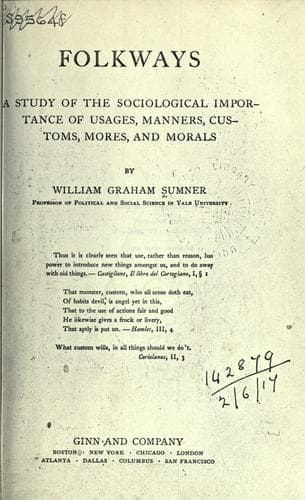
Folkways: A Study of the Sociological Importance of Usages, Manners, Customs, Mores, and MoralsSumner, William Graham
General
Folkways: A Study of the Sociological Importance of Usages, Manners, Customs, Mores, and Morals
Sumner, William Graham
Manners and customs
as a fulcrum for resisting decline, or producing recovery. In such a
period despair wins control. The philosophy is pessimistic. The world is
supposed to be coming to an end. Life is not valued. Ascetic practices
fall in with the prevailing temper. Martyrdom has no great terrors; such
as it has can be overcome by a little enthusiasm. Inroads of barbarians
only add a little to the other woes, or hasten an end which is
inevitable and is expected with resignation. At such a time a religion
of demonism, other-worldliness, resignation, retirement from the world,
and renunciation appeals both to those who want a dream of escape and to
those who despair. Our own time, on the other hand, is one of advance on
account of great unoccupied territories now opened at little or no cost
to those who have nothing. Such a period is one of hope, power, and gain
for the masses. Optimism is the philosophy. All the mores get their
spirit from it. "Progress" is an object of faith. A philosophy of
resignation and renunciation is unpopular. There is nothing which we
cannot do, and will not do, if we choose. No mistake will cost much. It
can be easily rectified. In the Renaissance in Italy, besides the
rejection of religion and the disorder of the state, there was a great
movement of new power derived from the knowledge which was changing the
life conditions. Great social forces were set loose. Men of heroic
dimensions, both in good and ill, appeared in great numbers. They had
astounding ability to accomplish achievements, and appeared to be
possessed by devils, so superhuman was their energy in vice and crime as
well as in war, art, discovery, and literature. No doubt this phenomenon
of heroic men belongs to an age of advance with a great upbursting of
new power under more favorable conditions. It is to be noticed also that
reproduction responds to conditions of advance or decline. In decline
marriage and family become irksome. Celibacy arises in the mores. In
times of advance sex vice and excess reach a degree, as in the
Renaissance, which seems to constitute a social paroxysm. The sex
passion rises to a frenzy to which everything else is sacrificed. The
notion that mores grow either better or worse by virtue of some inherent
tendency is to be rejected. Goodness or badness of the mores is always
relative only. Their purpose is to serve needs, and their quality is to
be defined by the degree to which they do it. We have noticed that there
is in them a strain towards consistency, due to the fact that they are
more efficient when consistent. They are consistent also in aberration
and error when they fall under the dominion of any one of the false
tendencies above described. Hence we may have the phenomena of
degenerate mores characterizing a period; being a case of change in the
mores not due to any external and determinable cause, and analogous
either to vice or disease.
Public-domain text, read in full here on John Shaqi.
Reviews
Reviews
No reviews yet
Be the first to share your thoughts on this work.
Elsewhere in the archive
Join the Discussion
Join the discussion
Sign in to leave a comment or review.
Sign InorCreate an account