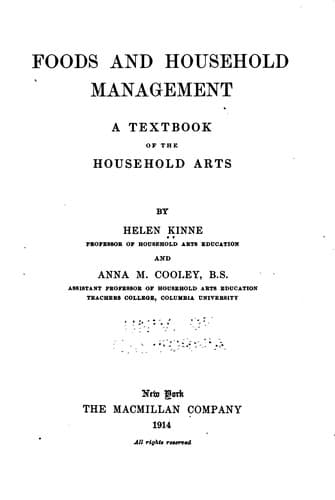
Foods and Household Management: A Textbook of the Household ArtsKinne, Helen
General
Foods and Household Management: A Textbook of the Household Arts
Kinne, Helen
Cooking; Food; Home economics
The price quoted for eggs is low, and even less could be obtained for ten
cents at prevailing prices in 1913-1914. This kind of estimate is a help
in making menus and dietaries. (See Chapter XVIII.) Another method of
estimating economy for this purpose is by calculating the cost of
100-Calorie portions of various food materials. A table giving such a
comparison will be found in the next chapter.
PURCHASING FOOD
In addition to the general principles of buying discussed in Chapter XXI
there are some details to be studied in purchasing food.
=Personal attention in buying food.=——It is absolutely necessary to visit
the market and the grocery where food is purchased. The purchaser would
not fail to visit a shop before deciding to patronize it regularly, but
frequent calls are necessary if buying is to be economical. Select the
grocery, market, and bakery with a view to their cleanliness. Notice if
the doors and windows are screened, and if proper effort is made to catch
flies that may have entered. Refuse to buy food that is exposed upon the
sidewalk, and if it is within doors, see that it is protected from dust
and flies. The best markets now have tiled walls and floors, which help to
insure cleanliness. The difference in odor is marked between a market that
is properly cleaned daily, and one where the proprietor uses uncleanly
methods. Meat and vegetables, in particular, should be personally selected
whenever this is possible. The butcher must understand that the purchaser
is familiar with the different cuts of meat and that honest service is
demanded in regard to the quality, trimming, and weight of the meat. One
does not want to be too suspicious, but it is well for the butcher to know
that the purchaser has a set of standard scales at home by which to prove
the accuracy of his weighing. It is also important to inspect fruit and
vegetables for quality and cost.
=Quantities in which to purchase food.=——The amount that one purchases of
a certain food depends on its keeping qualities, and upon the storage
space available at home. A general rule may be stated: Buy perishable
foods in small quantities; non-perishable foods in large. The reason for
buying in larger quantity is that the cost is somewhat less, although
sometimes it seems but little less. Some one has remarked that no one is a
good buyer who does not consider a quarter of a cent. In a modern house or
apartment where there is not room for a barrel of flour or sugar, then the
quantity must be gauged by the space. The same is true of canned goods as
of flour and sugar. Buying by the dozen saves a little on each can if you
have shelf room for piling the cans.
Public-domain text, read in full here on John Shaqi.
Reviews
Reviews
No reviews yet
Be the first to share your thoughts on this work.
Elsewhere in the archive
Join the Discussion
Join the discussion
Sign in to leave a comment or review.
Sign InorCreate an account