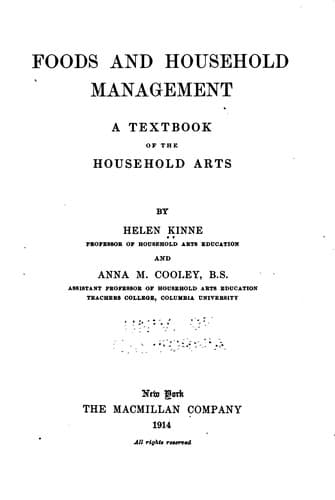
Foods and Household Management: A Textbook of the Household ArtsKinne, Helen
General
Foods and Household Management: A Textbook of the Household Arts
Kinne, Helen
Cooking; Food; Home economics
How shall we decide what is best for us in our buying? We must not condemn
entirely the buying of cooked food without a careful study of the
situation. The custom has grown with changes in our mode of living,
especially in cities, where the small apartment is common, and where gas
is the fuel. Under these conditions it is difficult to prepare foods that
need long and slow cooking, and these processes are more expensive when
gas is used. The long slow cooking of soup and beans, the even baking of
bread, are difficult to accomplish. The odors from these processes fill
the small apartment, and scent it for some time, and this is unpleasant at
all seasons.
Take another example, the canning and preserving of fruits. The first cost
of the fruit is usually high in the city, and this plus the sugar and the
gas, and the labor and the lack of storage space make it seem
impracticable in these conditions, and many people decide in favor of
buying goods already canned. Such housekeeping is simplified by buying
cooked products to some extent. The fireless cooker helps here, but not
for all processes. Counting in fuel, the cost is not so much greater as we
might suppose; and comfort and convenience are increased. Under other
conditions, even in the city, a different conclusion is reached. If coal
is the fuel, and a steady fire is kept, perhaps in winter for heating
purposes, then it is economy to cook most food materials at home.
In the country and small village different conditions prevail. Here the
abundance of certain fruits in season makes it economical to can and dry,
even counting fuel and labor. In some sections many people can their own
vegetables also. However, even in the country in the summer, it is a
decided relief to the farmer’s wife, probably short of “help,” to win a
little leisure by buying staple bakery products. Here if strict economy is
not necessary, is it not better to save strength rather than money? Each
housekeeper must work out these problems for herself.
EXERCISES
1. What are the more permanent factors in the cost of food material?
2. Why is vegetable food usually cheaper than animal food?
3. Explain the effect of season upon the cost.
4. Why does transportation affect the cost of food?
5. Why is clean milk more costly than unclean?
6. How do business conditions affect the cost?
7. Why is wheat bread a truly cheap food?
8. How can we estimate the cost of the actual nutrients in food?
9. Describe the working of the pure food law.
10. Why are such laws necessary?
11. How may we all aid in the passage and enforcement of pure food laws?
CHAPTER XVIII
MENUS AND DIETARIES[18]
Public-domain text, read in full here on John Shaqi.
Reviews
Reviews
No reviews yet
Be the first to share your thoughts on this work.
Elsewhere in the archive
Join the Discussion
Join the discussion
Sign in to leave a comment or review.
Sign InorCreate an account