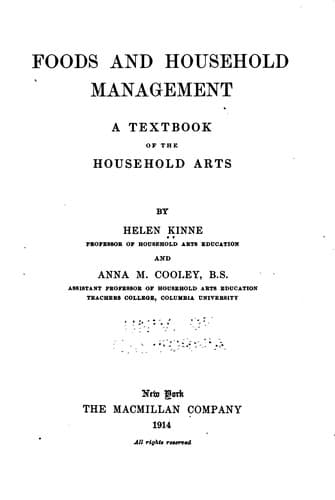
Foods and Household Management: A Textbook of the Household ArtsKinne, Helen
General
Foods and Household Management: A Textbook of the Household Arts
Kinne, Helen
Cooking; Food; Home economics
We may feel that the progress of the pure food movement has been most
satisfactory, even though much more remains to be done. The states
generally have either enacted new food laws, or revised their laws
following the national law. Under the national law over 2000 prosecutions
have already (1913) been decided in favor of the government.
Congress has passed an even more stringent law for meat inspection
supplementary to the Pure Food Law with ample appropriation for its
enforcement. Moreover, in 1913, the Secretary of Agriculture appointed
outside experts to inspect meat-packing establishments throughout the
country. This inspection is to check up the regular work being done by the
Bureau of Animal Industry.
The enforcing of federal and state laws has already largely stopped the
misbranding of package foods as to weight or measure, cheap substitutions,
the removal of valuable ingredients, and the sale of decomposed or tainted
food derived from diseased animals. Remember that abuses can be kept down
to any extent that we are willing to pay for. Taxpayers must appropriate
money to pay for inspection, for laws, no matter how good, will not insure
pure food unless carried out faithfully by an adequate number of specially
trained inspectors.
In the face of all these difficulties we must not be frightened into that
state of mind where danger seems to lurk in every mouthful. We must use
caution and common sense in our buying, and earnestly support every good
movement for bettering conditions.
There is a certain difference in quality even at a first class dealer’s
that one must learn to distinguish. One can of peaches will cost more than
another, because the peaches are larger. If it is only this, and there is
only a slight difference in flavor in favor of the more costly, buy the
cheaper by all means. A fancy brand of imported preserves brings a fancy
price which it is not worth while to pay. We have to learn to distinguish
between poor and good quality, on the one hand, and between good and what
may be called “fancy,” on the other. We should demand the good, but most
of us cannot afford the “fancy.”
=Ready-cooked foods.=——More and more cooked food, canned or otherwise, is
taking its place in the market. When canned goods were first manufactured
on a large scale they comprised fruits, vegetables, meats, and fish, but
we are now accustomed to a miscellaneous variety, including soups, baked
beans, puddings, and pudding sauces, spaghetti, hashed meat, and
shellfish. Bakery products have a larger sale than ever, and are found in
small towns, and even in country districts carried there by bakers’
wagons. In our large cities we find the “delicatessen shop” very common,
where small portions of cooked meats and fowl may be purchased after the
custom of Europe, and these stores are open even on Sunday.
Public-domain text, read in full here on John Shaqi.
Reviews
Reviews
No reviews yet
Be the first to share your thoughts on this work.
Elsewhere in the archive
Join the Discussion
Join the discussion
Sign in to leave a comment or review.
Sign InorCreate an account