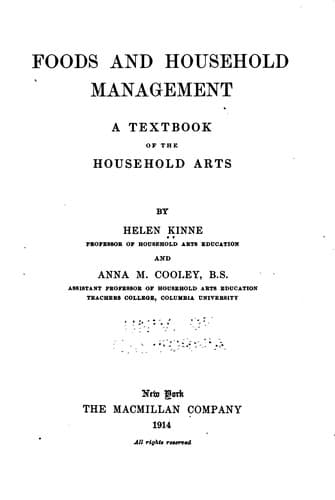
Foods and Household Management: A Textbook of the Household ArtsKinne, Helen
General
Foods and Household Management: A Textbook of the Household Arts
Kinne, Helen
Cooking; Food; Home economics
=Clothing.=——A large proportion of the family income is spent on clothing.
A knowledge of textiles and of purchasing is necessary in order to do this
wisely and economically. Clothing is as necessary an expense as food, for
it conserves the heat which the food furnishes and thus maintains body
temperature. Health is the main factor in efficiency, and health is
preserved by clothing which protects the body from sudden changes in
temperatures, and conserves the energy for other purposes. Money should be
spent on clothing to secure health, but too often more than the right
percentage of income is expended because of love of display. The instinct
for show, color, ornamentation is a primitive one, and the æsthetic “want”
is, in one sense, as real as the physical and should be considered in
expenditures for this purpose. It is a duty to look well, but it is not
necessary, nor does it show good sense, to sacrifice the health,
happiness, and higher life of the family by economizing on food and other
essentials in order to secure hats, shoes, gowns, and accessories that
cater to a mania for show. If the income be limited so that the essentials
of clothing only can be purchased, the margin of income which can be spent
for pleasure may, if taste so dictates, be spent on clothing instead of
pictures, books, or some recreation. That is a matter for the individual
or family to decide. In the typical budgets cited below it will be seen
that the expenditure for clothing was usually between 10 and 18 per cent.
=The higher life.=——There are other needs of family life for which money
must be spent besides the material ones of food, shelter, and clothing. In
the division of some family incomes little thought is given to this phase
of living. After the income reaches a certain amount, it is possible so to
plan that education, recreation, philanthropy, and savings all figure in
the division of expenditures. Some writers say that 25 per cent of the
income of $1000 to $5000 should be spent in this way. If thought is given
to this, it would mean opportunities for books, periodicals, lectures, and
membership in societies; some travel and vacation, social clubs, theaters
and concerts; charity and church expenditures; life insurance and other
savings. It is the idea of ownership of property, of homes, of possessions
of all kinds that has led from primitive living to advanced civilization.
And with advanced civilization comes the need for the higher life which
should be satisfied and can be through wise division of funds. The choice
of things to satisfy this higher life rests with the individual; it may be
music, it may be the cultivation of altruistic feeling in the help given
to neighbors; it may be a bank account for some future good, or money
spent on excursions, lectures, or theater. Whatever it is, it satisfies
the emotional, spiritual, and intellectual life of man and distinguishes
him as one of advanced civilization.
Public-domain text, read in full here on John Shaqi.
Reviews
Reviews
No reviews yet
Be the first to share your thoughts on this work.
Elsewhere in the archive
Join the Discussion
Join the discussion
Sign in to leave a comment or review.
Sign InorCreate an account