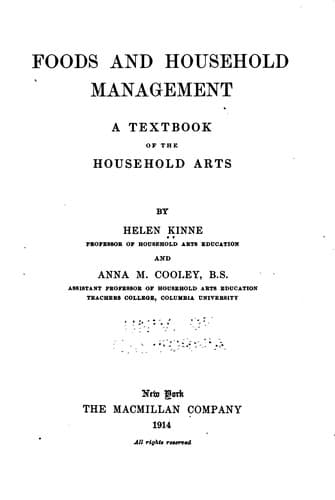
Foods and Household Management: A Textbook of the Household ArtsKinne, Helen
General
Foods and Household Management: A Textbook of the Household Arts
Kinne, Helen
Cooking; Food; Home economics
It has been estimated that 20 per cent of incomes ranging from $500 to
$5000 will secure a home, not including operating expenses, with the
proper sanitary conditions and one which will contribute to a right
standard of living. If necessary to secure healthful surroundings more
than 20 per cent may need to be spent, but 25 per cent of the income is
the limit of the amount to be spent upon rent unless this also includes
heat (as in many apartments) when as much as 28 per cent may be so spent.
If more than this is paid, it is practically impossible to avoid debt when
any unforeseen contingency arises. One thrifty German woman used 30 per
cent of the small family income for rent, in order to have more bedrooms
than most tenement-house dwellers can afford. She did make ends meet by
working until midnight at the family sewing, and tailoring; but though she
was the very soul of thrift in regard to food, and had never called in a
doctor, she could not save money until the children began to earn.
=Operating expenses.=——The question of operating expense is closely
associated with the selection of shelter and should be carefully
considered with it in the division of the income. They are the expenses
necessary to keep the house clean, warm, lighted, insured, and in constant
repair. To these must be added in a suburban community water tax, property
tax, perhaps even a fire tax.
In city apartments, heat and hot water are often furnished, and this must
be taken into account in deciding between apartment and house, and between
renting and ownership.
Labor is an important item in the running of the house. The close
connection of selecting and operating a home will be seen. Should the
administrator divide the family income in such a way that little is left
for operating, the little things of everyday life become a constant source
of worry.
The questions of the number of rooms, and their care, relative expense of
heating by furnace, steam, or hot water, the cost of regular service in
wages per week in order to attain one’s ideals, the cost of extra service,
the lighting by gas, oil, or electricity are all problems of operating.
Knowledge of sanitary science will make the homemaker demand cleanliness
in her surroundings, quick disposal of waste, and the prompt removal of
dust. Much care in planning is necessary here in order that there may be
no leakage and that there may be the full share of comfort for each
member.
For the income of from $500 to $5000 it has been estimated that a
proportion of from 10 to 20 per cent must usually be spent for operating
in order to secure comfort. Much must necessarily depend upon the amount
of hired service required, which, in turn, depends largely upon whether
the homemaker is to give her time chiefly to the care of her children or
chiefly to the conduct of the housework.
Public-domain text, read in full here on John Shaqi.
Reviews
Reviews
No reviews yet
Be the first to share your thoughts on this work.
Elsewhere in the archive
Join the Discussion
Join the discussion
Sign in to leave a comment or review.
Sign InorCreate an account