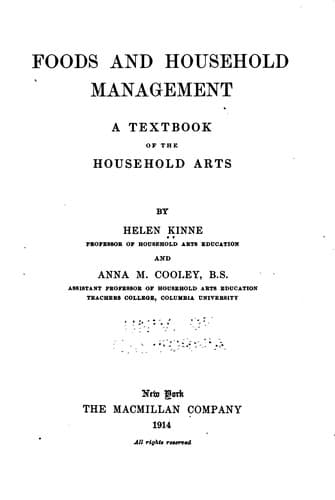
Foods and Household Management: A Textbook of the Household ArtsKinne, Helen
General
Foods and Household Management: A Textbook of the Household Arts
Kinne, Helen
Cooking; Food; Home economics
Once a month you should leave the book with the teller to be balanced. In
a few days you may call for it, and will receive with it the checks that
you have drawn, and that have been returned to the bank by the date to
which the book is balanced. These checks are called vouchers. With these
there is also a list of the amounts showing the total paid out on them by
the bank. Check up the vouchers with the list, then check up the vouchers
with your check book to see if all in your check book had been returned to
the bank by the date of balancing. If there are some still out, add that
sum to your check book balance, and then compare the bank book balance
with your check book.
Deposits may be sent by mail, either with or without the check book. If
the book is sent, it should go by registered mail. If you do not send the
book, the bank will send a receipt, which you return with the book the
next time the balance is made. In either case, write “For deposit” above
your signature on the back.
EXERCISES
1. Of what value is business equipment in household management?
2. Suggest ways in which a card file might be used in the household.
3. Suggest a system for filing household letters; bills.
4. What should be one’s aim in keeping household accounts?
5. Estimate the cost of your clothing for the last year.
6. Name different methods of payment of bills. Which do you consider the
best for the family with $1200 income?
7. Describe fully payment by check.
8. How should a check be indorsed?
9. How can one deposit checks by mail?
CHAPTER XXI
HOW TO BUY
The first rule in good buying is to know standard quality in your intended
purchase, for then you need not be dependent upon the salesman. The second
is to know your own needs, that you may not be beguiled by the clever
advertisement in the daily paper, or the well-displayed bargain, and will
not need to ask the salesman’s advice about quantity. Keep lists of
articles needed in the card file, and make your shopping lists from these.
The third rule is to apportion your purchases to your income and the
divisions of your budget.
=Where to buy.=——Patronize reliable firms. There are in any community
shops of different grades, and you will not find the best return for your
money always at those houses where there is the greatest parade of cut
prices and bargains. In the end the reliable places are the cheapest.
Sometimes a firm trades on its reputation and a degree of fashion it has
attained, but on the whole it is true that if one house has goods
uniformly cheaper than another, it is because the quality is inferior.
One fact that a good shopper learns is this——that certain articles may be
purchased to greater advantage at one place than another. One firm excels
in silks, another in household linen, another in coffee, and so on.
Public-domain text, read in full here on John Shaqi.
Reviews
Reviews
No reviews yet
Be the first to share your thoughts on this work.
Elsewhere in the archive
Join the Discussion
Join the discussion
Sign in to leave a comment or review.
Sign InorCreate an account