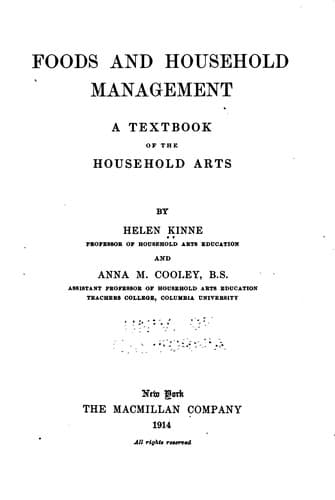
Foods and Household Management: A Textbook of the Household ArtsKinne, Helen
General
Foods and Household Management: A Textbook of the Household Arts
Kinne, Helen
Cooking; Food; Home economics
Prussian blue is to be avoided, since it is a salt of iron, and often
yellows or spots the clothes. It is usually sold in liquid form. To test,
mix the liquid blue with a strong solution of washing soda and heat. If
the mixture turns red, and there is a reddish precipitate, the blue is
this salt of iron.
=Starch= is used to fill the interstices of fabrics and give a smoothness
and stiffness to the cloth that prevents the rumpling of garments. Both
wheat and cornstarch are used for laundry purposes when only the natural
starches are available, the wheat starch being better for home laundering,
as the cornstarch gives a quality that is too stiff and crackling.
Recently, however, the manufacturers have learned to make “thin boiling”
starches from corn and have placed on the market a variety of such
modifications of cornstarch for laundry use. Rice starch or “rice water”
is used for very thin muslins.
_To make starch._——For method of making, see starch experiments, Chapter
VIII. The starch must be perfectly smooth, and should be stirred while it
is boiling for a few minutes, and strained.
_Proportions._
1. For lingerie, 1 teaspoonful of starch to 1 quart water.
2. For medium fabrics, 1-1/2 to 3 tablespoonfuls starch to 1 quart water.
3. For stiff work, 5 tablespoonfuls starch to 1 quart water.
=Ironing.=——The ironing process is the most difficult art in laundering,
and requires good tools, practice, and patience. In the summer it is an
exhausting labor unless an electric or gas iron is available. Much energy
may be saved in hot weather by omitting the ironing of certain articles.
Dish towels, even toilet towels, and soft underwear may be stretched and
folded, and are perfectly comfortable to use. Some women who do their own
work even fold sheets and pillow cases without ironing.
The smoothing of the fabric is accomplished by heated irons, or by
pressing between rollers in a mangle.
_To summarize._——The essential steps in laundering are: the forcing of
clear water through the fabric; loosening of the soil and stains by soap
and appropriate chemicals, sterilization by boiling temperature, drying
and sweetening in the air if possible. The less essential are bluing,
starching, and in some cases ironing.
Public-domain text, read in full here on John Shaqi.
Reviews
Reviews
No reviews yet
Be the first to share your thoughts on this work.
Elsewhere in the archive
Join the Discussion
Join the discussion
Sign in to leave a comment or review.
Sign InorCreate an account