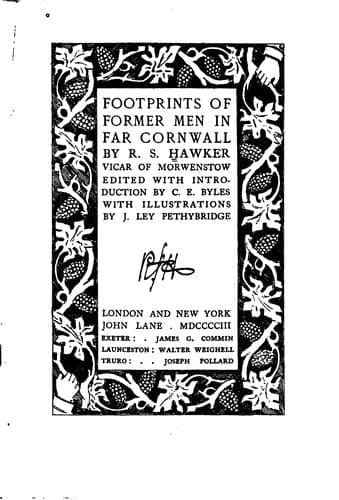
Footprints of Former Men in Far CornwallHawker, Robert Stephen
History
Footprints of Former Men in Far Cornwall
Hawker, Robert Stephen
Cornwall (England : County) -- History
There only remains to notice the last period of restoration, the
first time in which, as far as we can judge, granite was introduced
into the building. The date may be found on the westernmost of the
two pillars--MDLX4: on the other the words, “This is the House of the
Lord.” It is noticeable that the half polyphant pillar, which had at
one time formed the boundary of the arcade towards the east, was then
carried forwards and placed against the wall of the chancel. It thus
seems to mark, not only that the arcade was designed at different
periods, but that it was ultimately (the former portion being taken
down) all built together.
It was at this time (c. 1564) that the whole fabric of the church
(possibly not the chancel) was built [it may be clearly seen where
the new work stands on the old early English foundations on the north
side], the only remaining portion untaken down being the Norman and
early English pillars, and a portion of the wall by the south porch,
and (as before observed) possibly the chancel.
The tower was, we may consider, built at the same time as the church,
in 1564.
The seats, with their magnificent carving, followed in 1575, as is
testified by an inscription[161] on the rail of the front seat touching
the pulpit. This will, however, be removed in due course, the position
of these few seats being contrary to the original plan. I should think
that this rail and the seats also were formerly fixed where the font at
present stands at the end of the church.
As we stand within the walls and beneath the bending roofs of this
magnificent building, our mind naturally inquires what teaching its
designs serve to afford us--the cable on its font, the dog-tooth
pattern on its Norman arches. Is it really true that, following out
the established teaching of the nave, whereby the ship with inverted
side was depicted to us--is it really true that, following out this
idea, the cable implied the anchor by which every soul baptized into
Christ was bound _to_ Christ? Does the pattern, with its many points
(“dog-tooth,” as it is generally spoken of), really signify the ripple
on the Lake of Gennesaret? Do the three steps by which we enter allude
in very deed to the Baptism of John, the saint of dedication? It would
certainly seem probable that, having acknowledged the church to be the
nave or ship, we should not find that the imagery would end here, but
that it would pass into other matters which the mediæval times knew
so well how to formulate. If so, we have a rich vein of thought to be
wrought out from this ancient sanctuary of the West, all untouched as
it is by ruthless and destructive hands. Solemn be the thoughts of all
who enter here! Lowly and humble the hearts that here bend at the feet
of their great Liberator and Saviour! In the words of one who will long
be remembered in the parish which he loved so well, Robert Stephen
Hawker--
Public-domain text, read in full here on John Shaqi.
Reviews
Reviews
No reviews yet
Be the first to share your thoughts on this work.
Elsewhere in the archive
Join the Discussion
Join the discussion
Sign in to leave a comment or review.
Sign InorCreate an account