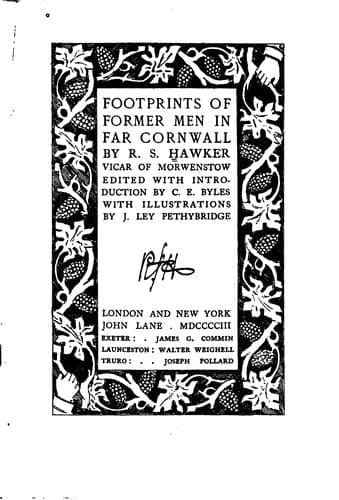
Footprints of Former Men in Far CornwallHawker, Robert Stephen
History
Footprints of Former Men in Far Cornwall
Hawker, Robert Stephen
Cornwall (England : County) -- History
“Pace we the ground! our footsteps tread
A cross--the builder’s holiest form:
That awful couch, where once was shed
The blood, with man’s forgiveness warm.
And here, just where His mighty breast
Throbb’d the last agony away,
They bade the voice of worship rest,
And white-robed Levites pause and pray.”
FOOTNOTE:
[161] The inscription runs as follows: “THIS · WAS · MADE · IN · THE ·
YERE · OF · OURE · LORDE · GOD · 1575.” The pew bearing it now stands
(1903) at the east end of the north aisle, facing south.--EDITOR.
APPENDIX A_b_ (pp. 16, 20, 203)
SUPERSTITIONS ABOUT NORTH AND EAST
Hunt, in his “Popular Romances of the West of England,” quotes
the following translation by the Rev. J. C. Atkinson from Hylten
Cuvalliec’s “Wärend och Wirdurne,” pp. 287-88. It agrees with many of
Hawker’s ideas.
“Inasmuch as all light and all vigour springs from the sun, our
Swedish forefathers always made their prayers with their faces
turned towards that luminary. When any spell or charm in connection
with an ‘earth-fast stone’ is practised, even in the present day,
for the removal of sickness, the patient invariably turns his face
towards the east, or the sun. When a child is to be carried to
church to be baptized, the Wärend usage is for the godmother first
to make her morning prayer, face towards the east, and then ask the
parents three several times what the child’s name is to be. The
dead are invariably interred with their feet lying eastward, so as
to have their faces turned towards the rising sun. _Frånsols_, or
with or in a northerly direction, is, on the other hand, according
to an ancient popular idea, _the home of the evil spirits. The
Old Northern Hell was placed far away in the North._ When any
one desires to remove or break any witch-spell, or the like,
by means of ‘reading’ (or charms), it is a matter particularly
observed that the stone (_i.e._ an ‘earth-fast’ one) is sought
to the northward of the house. In like manner also the ‘bearing
tree’ (any tree which produces fruit, or quasi fruit, apples,
pears, &c., _rowan tree_, especially, and white thorn herbs), or
the shrew mouse, by means of which it is hoped to remedy an evil
spell, must be met with in a northerly direction from the patient’s
home. Nay, if one wants to charm away sickness over (or into) a
running stream, it must always be one which runs northwards. On
the self-same grounds it has ever been the practice of the people
of the Wärend district, even down to the present time, not to
bring their dead _frånsols_--or to the northward--of the church.
In that part of the churchyard the contemned _främlings högen_
(strangers’ burial-place) always has its site, and in it are buried
malefactors, friendless wretches, and utter strangers. A very old
idea, in like manner, connects the north side of the church with
Public-domain text, read in full here on John Shaqi.
Reviews
Reviews
No reviews yet
Be the first to share your thoughts on this work.
Elsewhere in the archive
Join the Discussion
Join the discussion
Sign in to leave a comment or review.
Sign InorCreate an account