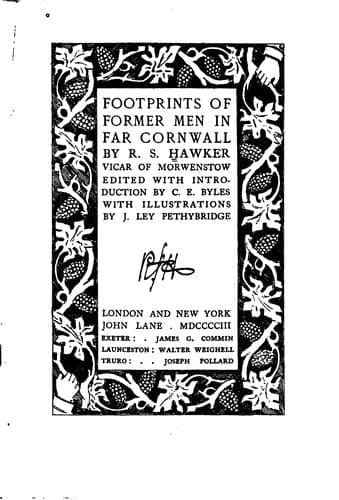
Footprints of Former Men in Far CornwallHawker, Robert Stephen
History
Footprints of Former Men in Far Cornwall
Hawker, Robert Stephen
Cornwall (England : County) -- History
APPENDIX E (p. 109)
ANTHONY PAYNE
BY THE REV. PREBENDARY ROGER GRANVILLE
According to the Episcopal Registers of the diocese of Exeter, a
marriage license was granted on September 12th, 1612, to “Anthony Payne
of Stratton, and Gertrude Deane of the same.” These were evidently the
parents of the famous Cornish giant, who served as henchman to Sir
Bevill Grenvile at Stowe.
When the Civil War broke out, Anthony Payne followed Sir Bevill to the
battlefield, and was doubtless present with him at the engagements of
Bradock Down, Modbury, and Sourton, in the early months of 1643. On the
16th of May the battle scene had shifted to his own home at Stratton,
where every inch of ground must have been perfectly familiar to him.
The Earl of Stamford had occupied a strong position on a hill within
a mile of the little town. From five in the morning till three in the
afternoon the battle raged, and though the Parliamentarians had the
superiority both of numbers and position, they could not prevail over
the brave Royalists. At three word was brought to Hopton and Grenvile
that their scanty stock of powder was almost exhausted. To retreat
would have been fatal. A supreme effort had to be made. Trusting
to pike and sword alone, the lithe Cornishmen pressed onwards and
upwards, led, can we doubt it, by Anthony Payne?
“His sword was made to match his size,
As Roundheads did remember;
And when it swung, ’twas like the whirl
Of windmills in September.”
The boldness of the attack seems to have struck their opponents with
terror. Stamford’s Horse turned and fled, and in vain Chudleigh
attempted to rally his Foot. He was surrounded and captured, and his
men, left without a commander, at once gave way and retreated, and
soon the victorious commanders embraced one another on the hard-won
hill-top, thanking God for a success for which, at one time, they had
hardly ventured to hope.
The following July Anthony Payne was at the battle of Lansdowne, near
Bath, where his brave master was mortally wounded. When Sir Bevill fell
the fight would have been lost for the King, and in another moment the
Cornish would have crowded down the hill. It was the quick nobility of
Anthony Payne which won the battle, and the deed should give him an
enduring place in history.
“Catching his master’s horse, with a fine knightly impulse, he
set little John Grenville, a lad of sixteen, who had followed his
gallant father close, on the hacked and gory saddle, and led him to
the head of his father’s troop. There was no more giving way after
this sight, and the Cornish followed the lad up the hill like men
possessed. By this time, too, the musketry had practically routed
the Parliament Horse, which were already retreating; and so, while
Sir Bevill lay dead on the hillside, his own regiment, led by
his giant servant and his little son, gained the top.” (Norway’s
“Highways and Byways in Devon and Cornwall,” p. 196.)
Public-domain text, read in full here on John Shaqi.
Reviews
Reviews
No reviews yet
Be the first to share your thoughts on this work.
Elsewhere in the archive
Join the Discussion
Join the discussion
Sign in to leave a comment or review.
Sign InorCreate an account