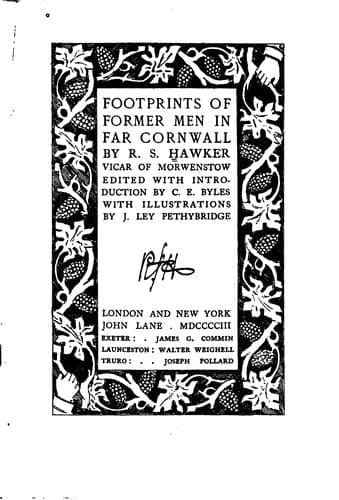
Footprints of Former Men in Far CornwallHawker, Robert Stephen
History
Footprints of Former Men in Far Cornwall
Hawker, Robert Stephen
Cornwall (England : County) -- History
There is surely “no finer story to be told than this; nor can there
have been, since first men began to slay each other, many sights more
noble than that of the child, tearful, excited, triumphant, set upon
the great charger, a world too high for him, and led up the hill at the
head of his dying father’s troop.” What wonder that the King knighted
the boy-warrior at Bristol on the 3rd of August following, for his
bravery at Lansdowne fight (cf. Metcalfe’s “Book of Knights,” p. 200),
or that Prince Charles, his own contemporary in age, attracted by his
heroism, chose him out of all others to be his personal attendant and
intimate friend ever afterwards--a friendship that was only broken by
death!
We wish that we could bring ourselves to believe that the letter (on
page 117), breathing the spirit of rare nobility, and stated by Mr.
Hawker to have been written to Lady Grace Grenvile after her valiant
husband’s death by his true-hearted giant retainer, was authentic. We
fear, however, that it originated in the study at Morwenstow, and is
the product of Mr. Hawker’s own versatile and gifted pen.
What became of Anthony Payne after this is not certainly known. Did he
return with his master’s body to Stowe, and remain on there to protect
his mistress during the four unquiet years of her widowhood? There
is, indeed, a tradition which would bear out this supposition, if it
is true. It relates that the poor Queen, in her flight (within a week
after her confinement) from Exeter, to avoid capture by Lord Essex,
escaped to Okehampton with a small body of attendants, where she was
met by Anthony Payne, who guided her to Stowe by a series of tracks and
lanes, in order to secure greater secrecy, and that from Stowe she went
to Lanherne, and so on to Falmouth, whence she escaped to France. In
confirmation of this theory a letter is said to have been seen from
Lady Grace, in which she mentions the fact of the Queen having slept at
Stowe, and of her departure to Lanherne. But the letter is no longer
extant, if it ever existed, and it has been proved pretty conclusively
by Mr. Paul Q. Karkeek, in a very interesting paper on the subject of
the Queen’s flight, that from Okehampton the Queen went to Launceston,
the most direct route, under the escort of Prince Maurice, and from
Launceston to Falmouth.
Or did Anthony Payne remain on with his young master, who narrowly
escaped meeting his father’s fate at the second battle of Newbury, and
afterwards took a prominent part in the defence of the West under his
uncle, Sir Richard Grenvile, and who so gallantly defended the Scilly
Islands, the last rallying point of the Royalists, against Admiral
Blake, in 1651, that he obtained exceptionally favourable terms when he
was at last compelled to capitulate?
Public-domain text, read in full here on John Shaqi.
Reviews
Reviews
No reviews yet
Be the first to share your thoughts on this work.
Elsewhere in the archive
Join the Discussion
Join the discussion
Sign in to leave a comment or review.
Sign InorCreate an account