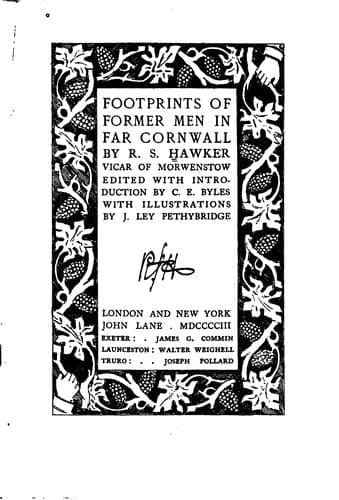
Footprints of Former Men in Far CornwallHawker, Robert Stephen
History
Footprints of Former Men in Far Cornwall
Hawker, Robert Stephen
Cornwall (England : County) -- History
Nothing is heard of Payne again till the Restoration. Then honours were
showered thickly on the Grenviles in recognition of all that they had
done and sacrificed for the royal cause, and especially of the signal
services they had rendered, in conjunction with their cousin, George
Monk, in restoring the Monarchy. Sir John Grenvile was created Earl
of Bath, and made Governor of Plymouth, where he at once undertook to
rebuild and strengthen the fortifications, which had been much damaged
in the late war. Upon their completion Lord Bath appointed Payne, whom
he evidently still held in great favour, as a yeoman of the guard and
halberdier of the guns. The King made a surprise visit by sea in July,
1671, to inspect the new citadel, accompanied by the Dukes of York and
Monmouth and a large retinue. They were entertained by Lord Bath at his
own cost with great profusion, and the Merry Monarch professed himself
highly pleased with his visit. It was probably on this occasion that
he commanded Sir Godfrey Kneller to paint Payne’s portrait,[163]
which is now in possession of the Royal Institution of Cornwall, at
Truro, and which was engraved as a frontispiece to the first volume of
Gilbert’s “History of Cornwall.”
Payne remained at Plymouth until old Time pulled the giant down.
Obtaining leave to retire, he returned home to Stratton, and died in
the same house in which he was born. It is now “The Tree Inn.” On the
wall is the following inscription, on a tablet which formerly marked
the battle-field.
In this Place
Y^e Army of y^e Rebels under y^e command
of y^e Earl of Stamford received a signal
overthrow by y^e valour of Sir Bevill Grenville
and y^e Cornish Army on Tuesday y^e
16th of May 1643.
But the only memento of poor Anthony Payne is a hole in the ceiling,
through which his coffin, being too large to be taken out of the window
or down the stairs in the usual way, was lowered from the room above.
Even the very place of his burial is uncertain. Some say he was buried
in the _north_, others in the _south_ aisle of Stratton Church, on July
13th, 1691, at an age which was little short of eighty years. Let us
hope that a sufficient number of appreciative friends may shortly be
found who shall be willing to contribute towards the erection of some
memorial in Stratton Church worthy of one who proved himself all his
days a faithful, loyal, true-hearted servant.
NOTE BY THE EDITOR.
In the parish register of Stratton, which begins in the year 1687, the
following entries appear:--
_Burials._
Sibilla, wife of Anthony Payne 9 July, 1691
Anthony Payne 13 „ „
William and Mary Payne 20 Aug., „
William Payne „ „ 1697
Richard, son of Anthony Payne 27 March, 1699
George „ „ „ „ 1708
Nicholas Payne 1 Aug., 1710
Public-domain text, read in full here on John Shaqi.
Reviews
Reviews
No reviews yet
Be the first to share your thoughts on this work.
Elsewhere in the archive
Join the Discussion
Join the discussion
Sign in to leave a comment or review.
Sign InorCreate an account