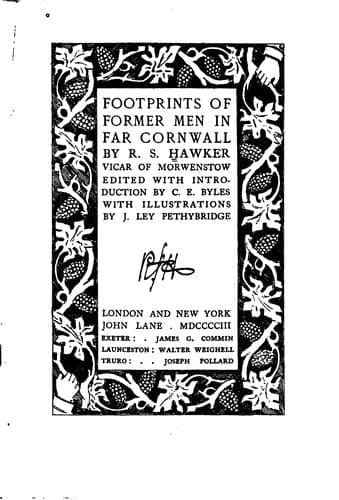
Footprints of Former Men in Far CornwallHawker, Robert Stephen
History
Footprints of Former Men in Far Cornwall
Hawker, Robert Stephen
Cornwall (England : County) -- History
The next male heir was George Granville the poet, who presented
his cousin, Chamond Granville, to the Rectory of Kilkhampton on
October 22nd, 1711, and on December 31st, 1711 (after serving in the
Parliaments called in the fourth and seventh years of Queen Anne), he
was created Lord Lansdowne of Bideford, “a promotion justly remarked to
be not invidious, inasmuch as he was at that time the heir of a family
in which two peerages, that of the Earl of Bath and Lord Granville of
Potheridge, had recently become extinct.”
Lord Lansdowne’s claim to the estates of the Earls of Bath was,
however, disputed by the two surviving daughters of John, first Earl of
Bath, viz. Lady Jane Leveson-Gower and Lady Grace Carteret. A family
law suit was the result of this claim, which lasted for some years.
With the death of Queen Anne (who had specially honoured him with her
favour, making him Comptroller of her household, and also Secretary of
State for War, and afterwards Treasurer) Lord Lansdowne’s prospects
darkened. He was supposed to be in favour of the exiled Stuarts rather
than of the House of Hanover; and there seems no little doubt that he
was more or less implicated in the scheme for raising an insurrection
in the West of England, which Lord Bolingbroke and the Duke of Ormonde
were at the head of. At any rate, Lord Lansdowne was seized as a
suspected person, and on September 26th, 1715, was committed, along
with Lady Lansdowne, to the Tower, where they were confined as close
prisoners. Whilst there he compromised the law suit for £30,000, and
the Devonshire property passed to Lady Jane Leveson-Gower, and the
Cornish to Lady Grace Carteret, who was created Countess Granville in
her own right.
Stowe, having stood for a little over half a century, was pulled down
in 1739. In Polwhele’s “History of Cornwall” it is stated that a man
of Stratton lived long enough to see its site a cornfield before the
building existed, and after the building was destroyed a cornfield
again. The materials were sold piecemeal by auction. The carved cedar
wood in the chapel, executed by Michael Chuke,[164] was bought by Lord
Cobham and applied to the same purpose at his mansion of Stowe in
Buckinghamshire. The staircase is at Prideaux Place, Padstow, while the
Corporation of South Molton, who were then building a new Town Hall,
Council Chamber, etc., purchased the following:--
Public-domain text, read in full here on John Shaqi.
Reviews
Reviews
No reviews yet
Be the first to share your thoughts on this work.
Elsewhere in the archive
Join the Discussion
Join the discussion
Sign in to leave a comment or review.
Sign InorCreate an account