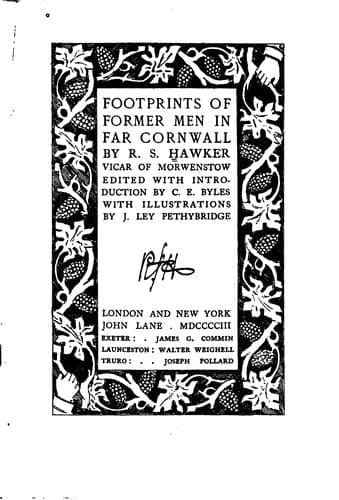
Footprints of Former Men in Far CornwallHawker, Robert Stephen
History
Footprints of Former Men in Far Cornwall
Hawker, Robert Stephen
Cornwall (England : County) -- History
Lady’s fine Bed-chamber and planching 35 0 0
9 shash windows at 10/6 and 2 at 11/6 5 17 6
no. 27 y^e winscott w^{th}out y^e chimney
and door casings 11 13 0
6 squares of Planching 1 16 0
A Tunn and 1/2 of Sheet & Pipe at 13/ 19 10 0
7 p^{rs.} of winscott window shutters at 8/ 2 16 0
172 rustic quoins at 1 8 12 0
4 Corinthian Capitalls & Pillasters 2 2 0
Y^e caseing and ornaments of 3 windows 1 11 6
3 Architraves w^{th} Pedem^{ts.} for doors &
27 y^{ds.} of winscott in the Lobby 2 2 0
A carved Cornish and Triumph of K.
Charles II. 7 7 0
2 right panel doors 1 1 0
These articles, with many others, were taken to Bude, shipped to
Barnstaple, and thence carted to South Molton. The outlay for the whole
only amounted to £178! The “carved Cornish and Triumph of Charles II.”
is still to be seen over the fireplace in the old dining-room in the
Town Hall at South Molton.
No doubt the isolated position of Stowe, and the long distance from
London was one cause of its being destroyed. Lord Carteret was
appointed Lord Lieutenant of Devonshire in 1716, and the previous
year he had been doing all he could in support of the new Hanoverian
establishment. While the Jacobite rebellion was at its height in
the north, Carteret was writing from Stowe to Robethon, the French
Secretary of George I.--
“I am now two hundred long miles from you, situated on a cliff
overlooking the sea, and every tide have fresh prospects in viewing
ships coming home. _In this corner of the earth_ have I received
your letter, and without that I should have heard nothing since I
came. Sept. 25, 1715.”--Brit. Mus. Sloane MSS. 4107, fol. 171, etc.
Another cause may have been the bursting of the “South Sea Bubble,” in
which Countess Granville and the Carterets had invested a good deal of
money. Lord Carteret wrote to a friend in October, 1720--
“I don’t know exactly how the fall of the South Sea has affected
my family, but they have lost considerably of what they had once
gained.”
The stables alone remain, and these have been converted into a
farmhouse, the tennis-court into a sheepcote, and the great quadrangle
into a rick-yard, and civilisation, spreading wave after wave so fast
elsewhere, has surged back from that lovely corner of the land, let us
hope only for a while.
Referring to this ruined mansion, Edward Moore exclaimed--
“Ah! where is now its boasted beauty fled?
Proud turrets that once glistened in the sky,
And broken columns, in confusion spread,
A rude mis-shapen heap of ruins lie!
Public-domain text, read in full here on John Shaqi.
Reviews
Reviews
No reviews yet
Be the first to share your thoughts on this work.
Elsewhere in the archive
Join the Discussion
Join the discussion
Sign in to leave a comment or review.
Sign InorCreate an account