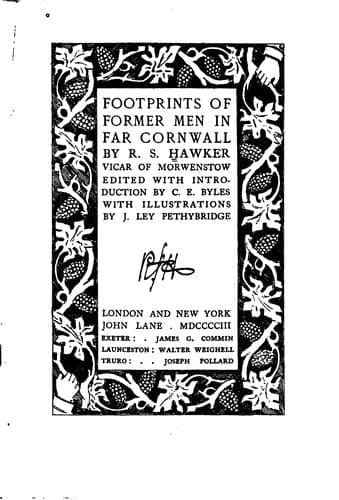
Footprints of Former Men in Far CornwallHawker, Robert Stephen
History
Footprints of Former Men in Far Cornwall
Hawker, Robert Stephen
Cornwall (England : County) -- History
Mr. W. H. Tregellas states that at the death of Sir John Percyvall,
about 1504, his widow retired to her native place; but Carew’s words
do not appear to justify this inference, and it is stated in the
Stocken MSS. in the Guildhall Library that she was buried at St. Mary
Woolnoth. Mr. Tregellas does not appear to have been able to trace the
will; but Lysons, whose account was published in 1814, says definitely
that the will was dated 1512, and this statement has been accepted by
subsequent writers. By this will she bequeathed to her brother, John
Bonaventer, £20; she made her cousin, John Dinham, who had married her
sister’s daughter, residuary legatee, and committed to his discretion
the chantry and grammar school founded in her lifetime; she gave a
little gilt goblet, having a blue flower in the bottom, to the Vicar
of Liskeard, to the intent that he should pray for her soul; and
towards the building of the tower of St. Stephen’s by Launceston she
left 20 marks. Robert Hunt, in his “Popular Romances of the West of
England,” says that Berry Comb, in Jacobstow, was once the residence of
Thomasine, and was given at her death to the poor of Week St. Mary. The
“Parochial History of Cornwall” gives 1530 as the approximate date of
her death.
APPENDIX H (pp. 161-62)
EPITAPHS OF RUDDLE AND BLIGH
The following is extracted from a little book entitled “Some Account
of the Church of St. Mary Magdalene, Launceston,” by S. R. Pattison,
1852:--
“Adjoining is a marble monument, in memory of Sarah, the wife of
the Rev. John Ruddle, interred near this place, in 1667. Below
the family arms is the following epitaph, entitled “The Husband’s
Valediction:”--
“Blest soul, since thou art fled into the slumbers of the dead,
Why should mine eyes
Let fall unfruitful tears, the offspring of despair and fears,
To interrupt thine obsequies.
No no, I won’t lament to see thy day of trouble spent;
But since thou art gone,
Farewell! sleep, take thy rest, upon a better Husband’s breast,
Until the resurrection.”
A stately monument of fine variegated marble, in the south aisle,
is charged with the arms of Bligh, and the following Latin
inscription:--
“Juxta hoc marmor jacet Carolus Bligh, Gen.
Aldermanus et hujus municipii sæpius Prætor
Qui cum sibe satis, suis parum diu vixerat
Pietate plenus obiit A.D. 1716, Die 8bris 2do
Hunc jam Æternitatem inhians Iudith uxor 27 Maii
An. Dni.
1717mo secuta est.”
The Botathen Ghost story, as told by “the Rev. Mr. Ruddell” himself,
occupies five pages of C. S. Gilbert’s “History Survey of Cornwall,
1817” (vol. i. pp. 115-119). Gilbert does not mention how he came by
it. Hawker’s version is obviously a paraphrase of this, with some
embellishments of his own.
APPENDIX J (p. 185)
MICHAEL SCOTT AND EILDON HILL
Public-domain text, read in full here on John Shaqi.
Reviews
Reviews
No reviews yet
Be the first to share your thoughts on this work.
Elsewhere in the archive
Join the Discussion
Join the discussion
Sign in to leave a comment or review.
Sign InorCreate an account