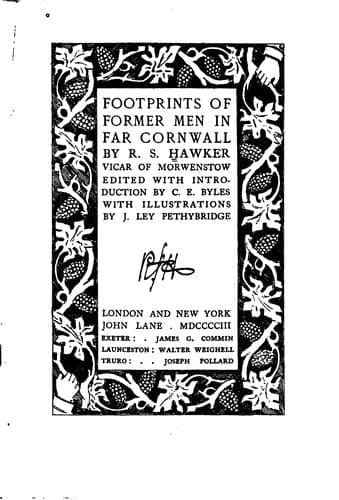
Footprints of Former Men in Far CornwallHawker, Robert Stephen
History
Footprints of Former Men in Far Cornwall
Hawker, Robert Stephen
Cornwall (England : County) -- History
Michael Scott, the Wizard of the North, was a mediæval scientist around
whose memory many traditions have gathered. Compare “The Lay of the
Last Minstrel,” canto 2, stanza 13. The Monk speaks.
“In these far climes it was my lot
To meet the wondrous Michael Scott;
A wizard of such dreaded fame,
That when, in Salamanca’s cave,
Him listed his magic wand to wave,
The bells would ring in Notre Dame!
Some of his skill he taught to me,
And, warrior, I could say to thee
The words that cleft Eildon Hills in three,
And bridled the Tweed with a curb of stone:
But to speak them were a deadly sin;
And for having but thought them my heart within,
A treble penance must be done.”
In the note on this passage Sir Walter says--
“In the South of Scotland any work of great labour or antiquity
is ascribed either to the agency of Auld Michael, of Sir William
Wallace, or of the devil.”
Gilfillan tells an amusing anecdote that--
“when Sir Walter was in Italy he happened to remark to Mr. Cheney
that it was mortifying to think how Dante thought none worth
sending to hell except Italians, on which Mr. C. remarked that he
of all men had no right to make this complaint, as his ancestor
Michael is introduced in the ‘Inferno.’ This seemed to delight
Scott.”
The passage in the “Inferno” occurs in Canto 20--
“Quell’ altro che ne’ fianchi è così poco,
Michele Scotto fu, che veramente
Delle magiche frode seppe il giuocho.”
translated by Cary thus:--
“That other, round the loins
So slender of his shape, was Michael Scott,
Practised in every slight of magic wile.”
Boccaccio also mentions him (Dec. Giorn. VIII., Nov. 9): “It is
not long since there was in this city (Florence) a great master
in necromancy, who was called Michele Scotto, because he was from
Scotland.” Legend has obscured the real fame of Michael Scott. He
lived between 1175 and 1234, studied at Oxford, Paris, Palermo, Toledo
(where he translated Aristotle from Arabic), and became court physician
and astrologer to the Emperor Frederick II. He took Holy Orders, but
declined the Pope’s offer of an Irish archbishopric on the ground of
not knowing the Irish language. He probably died in Italy, but fable
connects his burial with Holme Coltrame in Cumberland, or with Melrose
Abbey. It is said that Sir Walter Scott confused him with another
Michael Scott, of Balwearie, and that he “more probably belonged to
the border country whence all the families of Scot originally came,
and where the traditions of his magic power are common” (“Dict. of
Nat. Biog.”). The best book on the subject is the “Life and Legend of
Michael Scot (1175-1232),” by Rev. J. Wood Brown, M.A., 1897.
[_IN PREPARATION_]
The Life and Letters
of
Robert Stephen Hawker
Vicar of Morwenstow
Public-domain text, read in full here on John Shaqi.
Reviews
Reviews
No reviews yet
Be the first to share your thoughts on this work.
Elsewhere in the archive
Join the Discussion
Join the discussion
Sign in to leave a comment or review.
Sign InorCreate an account