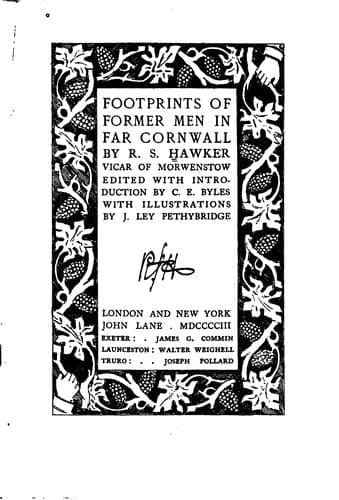
Footprints of Former Men in Far CornwallHawker, Robert Stephen
History
Footprints of Former Men in Far Cornwall
Hawker, Robert Stephen
Cornwall (England : County) -- History
“He ceased; and all around was dreamy night:
There stood Dundagel, throned: and the great sea
Lay, a strong vassal at his master’s gate,
And, like a drunken giant, sobb’d in sleep.”
There is an element of fiction in Hawker’s biographical studies.
He never let facts, or the absence of them, stand in the way of
his imagination, and he had a Chattertonian habit of passing off
compositions of his own as ancient manuscripts.
His letters are full of complaints that legends “invented” by himself
have been regarded by others as common property. But this is not
surprising when the said inventions wear the solemn garb of history.
Hawker had many of the qualities necessary to historical romance. His
rich native humour, and his rare gift for telling a story; his vivid
presentment of scene, character, and situation, make it a matter of
regret that he did not apply his powers more fully in this direction,
just as it is a matter of regret that his fine poem, “The Quest of the
Sangraal,” is only a fragment, though a fragment worthy to rank beside
“Hyperion.”
Both in his prose and his poetry there is a disappointing lack of
sustained effort. His literary manner and antiquarian tastes bear
many points of resemblance to those of Scott, whose novels it was his
custom to re-read every year as Christmas-time came round. In his local
and scanty degree Hawker has done for the legends and worthies of old
Cornwall what Sir Walter did for those of Scotland.
The prose impulse seems to have moved Hawker somewhat late in life,
all the following papers having been published since 1850, when he had
reached the age of forty-seven. These papers, as a matter of fact,
represent a brave effort in years of increasing pecuniary anxiety to
add to his income by his pen. His letters contain many interesting
allusions to his literary struggles and his dealings with the
editors of his day, among whom were Froude and Dickens. He also met
or corresponded with several other famous contemporaries, including
Tennyson, Longfellow, Kingsley, and Cardinals Newman and Manning.
Earlier, too, he had a correspondence with Macaulay. But on these
matters it will be more fitting to enlarge in the new memoir of Hawker,
which is in course of preparation.
Public-domain text, read in full here on John Shaqi.
Reviews
Reviews
No reviews yet
Be the first to share your thoughts on this work.
Join the Discussion
Join the discussion
Sign in to leave a comment or review.
Sign InorCreate an account