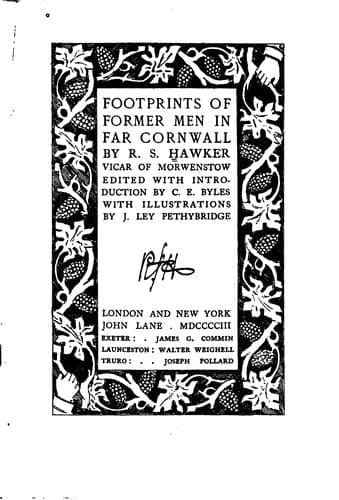
Footprints of Former Men in Far CornwallHawker, Robert Stephen
History
Footprints of Former Men in Far Cornwall
Hawker, Robert Stephen
Cornwall (England : County) -- History
“Thank God, thou whining knave! on land,
But thank, at sea, the steersman’s hand.”
[34] The scene of this legend is pointed out in the garden at Tonacombe
Manor.
THE GAUGER’S POCKET[35]
Poor old Tristram Pentire! How he comes up before me as I pronounce his
name! That light, active, half-stooping form, bent as though he had a
brace of kegs upon his shoulders still; those thin, grey, rusty locks
that fell upon a forehead seamed with the wrinkles of threescore years
and five; the cunning glance that questioned in his eye, and that nose
carried always at half-cock, with a red blaze along its ridge, scorched
by the departing footstep of the fierce fiend Alcohol, when he fled
before the reinforcements of the coast-guard.
He was the last of the smugglers; and when I took possession of my
glebe, I hired him as my servant-of-all-work, or rather no-work, about
the house, and there he rollicked away the last few years of his
careless existence, in all the pomp and idleness of “The parson’s man.”
He had taken a bold part in every landing on the coast, man and boy,
full forty years; throughout which time all kinds of men had largely
trusted him with their brandy and their lives, and true and faithful
had he been to them, as sheath to steel.
Gradually he grew attached to me, and I could but take an interest in
him. I endeavoured to work some softening change in him, and to awaken
a certain sense of the errors of his former life. Sometimes, as a sort
of condescension on his part, he brought himself to concede and to
acknowledge, in his own quaint, rambling way--
“Well, sir, I do think, when I come to look back, and to consider what
lives we used to live,--drunk all night and idle abed all day, cursing,
swearing, fighting, gambling, lying, and always prepared to shet
[shoot] the gauger,--I do really believe, sir, we surely was in sin!”
But, whatever contrite admissions to this extent were extorted
from old Tristram by misty glimpses of a moral sense and by his
desire to gratify his master, there were two points on which he was
inexorably firm. The one was, that it was a very guilty practice in
the authorities to demand taxes for what he called run goods; and the
other settled dogma of his creed was, that it never could be a sin
to make away with an exciseman. Battles between Tristram and myself
on these themes were frequent and fierce; but I am bound to confess
that he always managed, somehow or other, to remain master of the
field. Indeed, what Chancellor of the Exchequer could be prepared to
encounter the triumphant demand with which Tristram smashed to atoms
my suggestions of morality, political economy, and finance? He would
listen with apparent patience to all my solemn and secular pleas
for the revenue, and then down he came upon me with the unanswerable
argument--
“But why should the king tax good liquor? If they _must_ have taxes,
why can’t they tax something else?”
Public-domain text, read in full here on John Shaqi.
Reviews
Reviews
No reviews yet
Be the first to share your thoughts on this work.
Join the Discussion
Join the discussion
Sign in to leave a comment or review.
Sign InorCreate an account