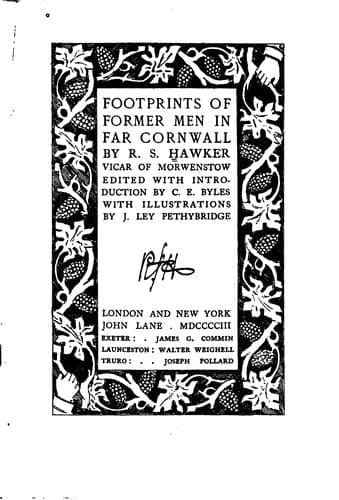
Footprints of Former Men in Far CornwallHawker, Robert Stephen
History
Footprints of Former Men in Far Cornwall
Hawker, Robert Stephen
Cornwall (England : County) -- History
In a moment I was up, and in my dressing-gown and slippers rushed
out. There stood my lad, weeping bitterly, and holding out to me in
his trembling hands a tortoise alive. I found afterwards that he had
grasped it on the beach, and brought it in his hand as a strange and
marvellous arrival from the waves, but in utter ignorance of what it
might be. I ran across my glebe, a quarter of a mile, to the cliffs,
and down a frightful descent of three hundred feet to the beach. It was
indeed a scene to be looked on once only in a human life. On a ridge of
rock, just left bare by the falling tide, stood a man, my own servant;
he had come out to see my flock of ewes, and had found the awful
wreck. There he stood, with two dead sailors at his feet, whom he had
just drawn out of the water stiff and stark. The bay was tossing and
seething with a tangled mass of rigging, sails, and broken fragments
of a ship; the billows rolled up yellow with corn, for the cargo of
the vessel had been foreign wheat; and ever and anon there came up out
of the water, as though stretched out with life, a human hand and arm.
It was the corpse of another sailor drifting out to sea. “Is there
no one alive?” was my first question to my man. “I think there is,
sir,” he said, “for just now I thought I heard a cry.” I made haste
in the direction he pointed out, and, on turning a rock, just where
a brook of fresh water fell towards the sea, there lay the body of a
man in a seaman’s garb. He had reached the water faint with thirst,
but was too much exhausted to swallow or drink. He opened his eyes at
our voices, and as he saw me leaning over him in my cassock-shaped
dressing-gown, he sobbed, with a piteous cry, “O mon père, mon père!”
Gradually he revived, and when he had fully come to himself with the
help of cordials and food, we gathered from him the mournful tale of
his vessel and her wreck. He was a Jersey man by birth, and had been
shipped at Malta, on the homeward voyage of the vessel from the port of
Odessa with corn. I had sent in for brandy, and was pouring it down his
throat, when my parishioner, Peter Burrow, arrived. He assisted, at my
request, in the charitable office of restoring the exhausted stranger;
but when he was refreshed and could stand upon his feet, I remarked
that Peter did not seem so elated as in common decency I expected he
would be. The reason soon transpired. Taking me aside, he whispered in
my ear, “Now, sir, I beg your pardon, but if you’ll take my advice, now
that man is come to himself, if I were you I would let him go his way
wherever he will. If you take him into your house, he’ll surely do you
some harm.” Seeing my surprise, he went on to explain, “You don’t know,
sir,” he said, “the saying on our coast--
“‘Save a stranger from the sea,
And he’ll turn your enemy.’
Public-domain text, read in full here on John Shaqi.
Reviews
Reviews
No reviews yet
Be the first to share your thoughts on this work.
Join the Discussion
Join the discussion
Sign in to leave a comment or review.
Sign InorCreate an account