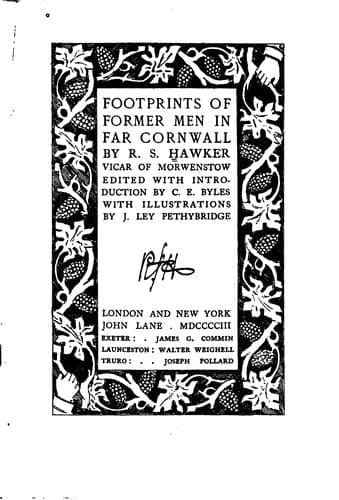
Footprints of Former Men in Far CornwallHawker, Robert Stephen
History
Footprints of Former Men in Far Cornwall
Hawker, Robert Stephen
Cornwall (England : County) -- History
Black John’s lair was a rude hut, which he had wattled for a snug
abode, close to the kennel. He loved to retire to it, and sleep near
his chosen companions, the hounds. When they were unkennelled, he
accompanied and ran with them afoot, and so sinewy and so swift was his
stunted form that he was very often in their midst at the death. Then,
with the brush of the fox elaborately disposed as the crest of his felt
hat, John would make his appearance on the following Sunday at church,
where it was displayed, and pompously hung up above his accustomed
seat, to his own great delight and the envy of many among the
congregation. When the pack found the fox, and the huntsman’s ear was
gladdened by their shrill and sudden burst into full cry, Black John’s
shout would be heard in the field, with his standing jest, “There they
go! there they go! like our missus at home in one of her storms!” As he
grew older, and less equal to the exertion of his strong and youthful
days, John took to wandering, gipsy-fashion, about the country-side;
and he found food and welcome at every cottage and farmhouse. His
usual couch was among the reeds or fern of some sheltering brake or
wood, and he slept, as he himself used to express it, “rolled up, as
warm as a hedgeboar, round his own nose.” One day, in bitter snowy
weather, he was found wanting from his accustomed haunts--“one morn
they missed him on the usual hill”--and after long search he was
discovered shrouded in snow, cold, stiffened, and to all outward
appearance dead. He was carried home, and in due course was coffined
and borne towards the grave. But there, just as the clergyman[59] who
read the service had reached the solemn words which commit the body
to the ground, a loud thumping noise was heard within the coffin.
The bystanders rent open the lid in hot haste, and up started Black
John alive, in amazement, and in furious wrath. He had been in a long
_deliquium_, or death-trance,[60] from cold, and had been restored to
life by the motion and warmth of his own funeral ride. As he told the
astonished mourners, “He heard the words ‘dust to dust,’ and then,”
said he, “I thought it was high time to bumpy.” His words passed into
a proverb; and to this very day, when Cornish men in these parts are
placed in some sudden extremity, and it becomes necessary to take
strong and immediate measures for extrication, the saying is, “It is
time to bumpy, as Black John said.” In his anger and mental confusion,
Black John ever after attributed his attempted burial to the conspiracy
and ill-will of the clergyman, whose words he had interrupted by his
sudden resurrection. More than once the reverend gentleman was suddenly
assaulted in his walks by a stone hurled at him from a hedge, followed
by an angry outcry, in a well-known voice, of “Ha! old Dust-to-dust;
here I be, alive and kicking!”
Public-domain text, read in full here on John Shaqi.
Reviews
Reviews
No reviews yet
Be the first to share your thoughts on this work.
Join the Discussion
Join the discussion
Sign in to leave a comment or review.
Sign InorCreate an account