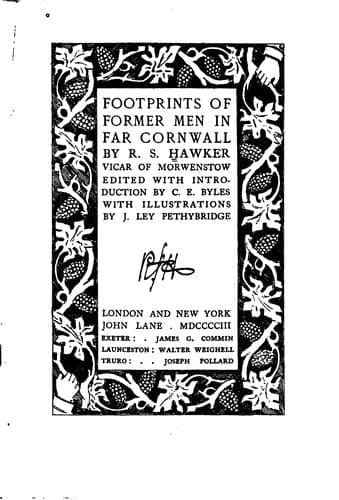
Footprints of Former Men in Far CornwallHawker, Robert Stephen
History
Footprints of Former Men in Far Cornwall
Hawker, Robert Stephen
Cornwall (England : County) -- History
[58] Another version of the story says that he was a shoemaker come on
business, and that he never made boots for Mr. Arscott again. For the
fate of the other toad, see end of Appendix C.
[59] The Rev. Robert Martyn, then Vicar of Stratton.
[60] On another occasion Black John awoke from a less serious trance.
The parson in his sermon was speaking of “that blessedness which on
earth it is impossible to find,” when a well-known voice from the
gallery shouted, “Not find! Us be sartain to find un to-morrow in
Swannacott Wood!”
[61] In another version of the tale, Black John said to the preacher,
“Only just take your hat off and say two words of gospel to ’im, and
her won’t touch ’ee.”
[62] This is one stanza from Hawker’s own poem, “Tetcott, 1831; in
which year Sir William Molesworth caused the old house to be taken
down, and a new one built.” (See Appendix C.)
[63] These lines are from Hawker’s poem, “A Legend of the Hive.”
DANIEL GUMB’S ROCK[64]
There is no part of our native country of England so little known, no
region so seldom trodden by the feet of the tourist or the traveller,
as the middle moorland of old Cornwall. A stretch of wild heath and
stunted gorse, dotted with swelling hills, and interspersed with
rugged rocks, either of native granite or rough-hewn pillar, the rude
memorial of ancient art, spreads from the Severn Sea on the west to the
tall ridge of Carradon on the east, and from Warbstow Barrow on the
north to the southern civilisation of Bodmin and Liskeard. Throughout
this district there is, even in these days, but very scanty sign of
settled habitation. Two or three recent and solitary roads traverse
the boundaries; here and there the shafts and machinery of a mine
announce the existence of underground life; a few clustered cottages,
or huts, for the shepherds, are sprinkled along the waste; but the
vast and uncultured surface of the soil is suggestive of the bleak
steppes of Tartary or the far wilds of Australia, and that in the very
heart of modern England. Yet is there no scenery that can be sought
by the antiquary or the artist that will so kindle the imagination or
requite the eye or the mind of the wanderer as this Cornish solitude.
If he travel from our storied Dundagel, eastward, Rowter,[65] the
Red Tor, so named from its purple tapestry of heather and heath, and
Brunguillie,[66] the Golden Hill, crested with yellow gorse like a
crown, will win his approach and reward, with their majestic horizon,
the first efforts of his pilgrimage. The summits and sides of these
mountains of the west are studded with many a logan-rock[67] or
shuddering-stone of the old superstition. This was the pillar of ordeal
in Druid times, so poised that while it shook at the slight faint touch
of the innocent finger, it firmly withstood the assailing strength of
the guilty man.
Public-domain text, read in full here on John Shaqi.
Reviews
Reviews
No reviews yet
Be the first to share your thoughts on this work.
Join the Discussion
Join the discussion
Sign in to leave a comment or review.
Sign InorCreate an account