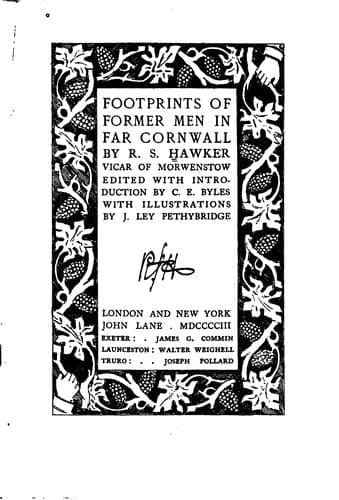
Footprints of Former Men in Far CornwallHawker, Robert Stephen
History
Footprints of Former Men in Far Cornwall
Hawker, Robert Stephen
Cornwall (England : County) -- History
[73] This is probably a slip of the pen for “Virgilian.” The line
occurs in Virgil’s “Eclogues,” 8, 43. There is no stop at “illum.” The
sentence is carried on to the next lines--
“Aut Tmaros aut Rhodope aut extremi Garamantes
Nec generis nostri puerum nec sanguinis edunt.”
Conington translates the passage thus: “Now know I what love is; it
is among savage rocks that he is produced by Tmarus or Rhodope or the
Garamantes at earth’s end; no child of lineage or blood like ours.”
Hawker’s translation, it must be owned, is preferable as far as it goes.
[74] Evidences of thought and style make it almost certain that these
ingenious “fragments” are Hawker’s “own invention.” See note on p. 104.
[75] It was a trick of Hawker’s style to end a sentence with this
or similar adverbs. Instances occur on pp. 17 and 172. Elsewhere he
writes: “As the lightning leaps from the dark cloud suddenly.” Little
points like this suggest the real authorship of Daniel Gumb’s diary.
[76] Numbers xxiv. 21, “And he (Balaam) looked on the Kenites, and
took up his parable, and said, Strong is thy dwelling-place, and thou
puttest thy nest in a rock.”
ANTONY PAYNE, A CORNISH
GIANT[77]
On the brow of a lofty hill, crested with stag-horned trees, commanding
a deep and woodland gorge wherein “the Crooks of Combe”[78] (the curves
of a winding river) urge onward to the “Severn Sea,” still survive
the remains of famous old Stowe,--that historic abode of the loyal
and glorious Sir Beville,[79] the Bayard of old Cornwall, “sans peur
et sans reproche,” in the thrilling Stuart wars. No mansion on the
Tamar-side ever accumulated so rich and varied a store of association
and event. Thither the sons of the Cornish gentry were accustomed to
resort, to be nurtured and brought up with the children of Sir Beville
Granville and Lady Grace; for the noble knight was literally the “glass
wherein” the youth of those ancient times “did dress themselves.” There
their graver studies were relieved by manly pastime and athletic
exercise. Like the children of the Persians, they were taught “to
ride, to bend the bow, and to speak the truth.” At hearth and hall
every time-honoured usage and festive celebration was carefully and
reverently preserved. Around the walls branched the massive antlers
of the red deer of the moors, the trophies of many a bold achievement
with horse and hound. At the buttery-hatch hung a tankard marked with
the guests’ and the travellers’ peg, and a manchet, flanked with
native cheese, stood ready on a trencher for any sudden visitant who
might choose to lift the latch; for the Granville motto was, “An open
door and a greeting hand.” A troop of retainers, servants, grooms,
and varlets of the yard, stood each in his place, and under orders to
receive with a welcome the unknown stranger, as well as their master’s
kinsman and friend.
[Illustration: ANTONY PAYNE’S HOUSE, STRATTON, now the Tree Inn.]
Public-domain text, read in full here on John Shaqi.
Reviews
Reviews
No reviews yet
Be the first to share your thoughts on this work.
Elsewhere in the archive
Join the Discussion
Join the discussion
Sign in to leave a comment or review.
Sign InorCreate an account