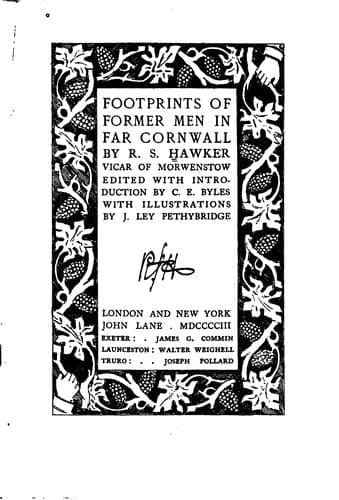
Footprints of Former Men in Far CornwallHawker, Robert Stephen
History
Footprints of Former Men in Far Cornwall
Hawker, Robert Stephen
Cornwall (England : County) -- History
Among these, at the beginning of the seventeenth century, appeared a
remarkable personage. He was the son of an old tenant on the estate,
who occupied the manor-house of Stratton, a neighbouring town. His
parents were of the yeoman rank in life, and possessed no singularity
of personal aspect or frame, although both were comely. But Antony,
their son, was from his earliest years a wonderful boy. He shot up
into preternatural stature and strength. His proportions were so vast
that, when he was a mere lad, his schoolmates were accustomed to
“borrow his back,” and, for sport, to work out their geography lessons
or arithmetic on that broad disc in chalk; so that, to his mother’s
amazement and dismay, he more than once brought home, like Atlas, the
world on his shoulders, for her to rub out. His strength and skill in
every boyish game were marvellous, and, unlike many other large men,
his mental and intellectual faculties increased with his amazing growth.
It was Antony Payne’s delight to select two of his stoutest companions,
whom he termed “his kittens,” and, with one under each arm, to climb
some perilous crag or cliff in the neighbourhood of the sea, “to show
them the world,” as he said. He was called in the school “Uncle Tony,”
for the Cornish to this day employ the names “uncle and aunt” as titles
of endearment and respect. Another relic of his boyhood is extant
still: the country lads, when they describe anything of excessive
dimensions, call it, “As long as Tony Payne’s foot.”
He grew on gradually, and in accurate proportion of sinews and thews,
until, at the age of twenty-one, he was taken into the establishment at
Stowe. He then measured seven feet two inches without his shoes,[80]
and he afterwards added a couple of inches more to his stately growth.
Wide-chested, full-armed, and pillared like a rock on lower limbs of
ample and exact symmetry, he would have gladdened the critical eyes of
Queen Elizabeth, whose Tudor taste led her to exult in “looking on a
man.” If his lot had fallen in later days, he might have been hired by
some wonder-monger to astonish the provincial mind, or the intellect of
cities, as the Cornish Chang. But in good, old, honest, simple-hearted
England, they utilised their giants, and deemed that when a cubit was
added to the stature of a man, it was for some wise good end, and they
looked upon their loftier brother with added honour and respect.
Public-domain text, read in full here on John Shaqi.
Reviews
Reviews
No reviews yet
Be the first to share your thoughts on this work.
Elsewhere in the archive
Join the Discussion
Join the discussion
Sign in to leave a comment or review.
Sign InorCreate an account