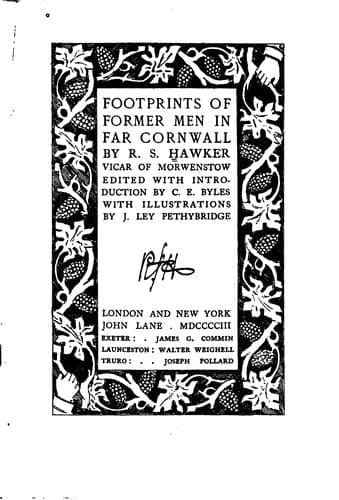
Footprints of Former Men in Far CornwallHawker, Robert Stephen
History
Footprints of Former Men in Far Cornwall
Hawker, Robert Stephen
Cornwall (England : County) -- History
The aspect of rural England during the fifteenth and sixteenth
centuries must have presented a strange and striking contrast, in
the eye of a traveller, to the agricultural scenery of our own time.
Thinly peopled--for the three millions of our chief city nowadays are
in excess of the total population of the whole land of the Edwards and
the Henrys--the inhabitants occupied hamlets few and far between, and
a farm or grange signified usually a moated house amid a cluster of
cultivated fields, gathered within fences from the surrounding forest
or wold, and gleaming in the distance with rich or green enclosures,
rescued from the wilderness, to give “fodder to the cattle, and bread
to strengthen the heart of man.” But the great domains of the land for
the most part expanded into woodland and marsh and moor, with glades
or grassy avenues here and there for access to the lair of the red
deer or the wild boar, or other native game, which afforded in that
day a principal supply of human food. Yonder in the distance appeared
ever and anon a beacon-tower, which marked the place and ward for the
warning of hostile advances by night, and for the gathering rest of the
hobbelars or horsemen, whose office it was to scour the country and to
keep in awe the enemies of God and the king. Wheel-roads, except in
the neighbourhood of cities or on the line of a royal progress, there
were none; and among the bridle-paths men urged their difficult path
in companies, for it was seldom safe for an honest or well-to-do man
to travel alone. Rivers glided in silence to the sea without a sail
or an oar to ruffle their waters; and there were whole regions, that
now are loud with populous life, that might then have been called void
places of the uninhabited earth. But more especially did this character
of uncultured desolation pervade the extreme borders of the west of
England, the country between the Tamar and the sea. There dwelt in
scattered villages, or town-places as they are called to this day, the
bold and hardy Keltic people, few in number, but, like the race of the
Eastern wild man, never taught to bear the yoke. Long after other parts
of England had settled into an improved agriculture, and submitted to
the discipline of more civilised life, the Cornish were wont to hew
their resources out of the bowels of their mother earth, or to haul
into their nets the native harvest of the sea. Thus the merchandise
of fish, tin, and copper became the vaunted staple of their land.
These, the rich productions of their native county, were, even in
remote periods of our history, in perpetual request, and formed,
together with the wool of their moorland flocks, the great trade of
the Cornish people. From all parts, and especially from that storied
city whose merchants were then, as now, princes of the land, men were
wont to encounter the perilous journey from the Thames to the Tamar,
to pursue their traffic with the “underground folk,” as they termed
Public-domain text, read in full here on John Shaqi.
Reviews
Reviews
No reviews yet
Be the first to share your thoughts on this work.
Elsewhere in the archive
Join the Discussion
Join the discussion
Sign in to leave a comment or review.
Sign InorCreate an account