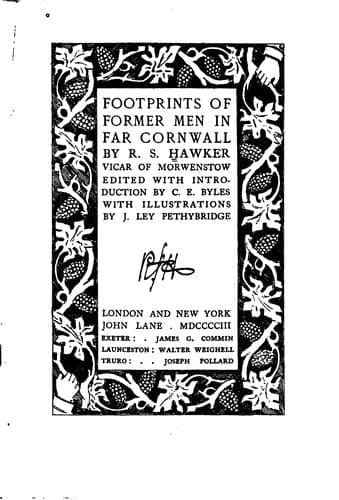
Footprints of Former Men in Far CornwallHawker, Robert Stephen
History
Footprints of Former Men in Far Cornwall
Hawker, Robert Stephen
Cornwall (England : County) -- History
the inhabitants of Cornwall, that rocky land of strangers, as, when
literally interpreted, is the exact meaning of its name.
It was in the year 1463, when Edward IV. occupied the English throne,
that a tall and portly merchant, in the distinctive apparel of the
times, rode along the wilds of a Cornish moor. He sat high and firm
upon his horse, a bony gelding, with demipique saddle. A broad
beaver, or, as it was then called, a Flanders hat, shaded a grave and
thoughtful countenance, wherein shrewdness and good-humour struggled
for the mastery and the latter prevailed, and his full brown beard was
forked--a happy omen, as it was always held, of prosperous life. His
riding garb displayed that contrast of colours which was then so valued
by native taste, insomuch that the phrase “motley” had in its origin a
complimentary and not an invidious sound. Behind him and near rode his
servant, a stout and active-looking knave, armed to the teeth.
The traveller had crossed the ford of a moorland stream, when he halted
and reined up at a scene that greeted him on the bank. There, on a
green and rushy knoll and underneath a gnarled and wind-swept tree, a
damsel in the blossom of youth stood leaning on her shepherd-staff: her
companion, a peasant boy, drew back, half shaded by a rock. Sheep of
the native breed, the long-forgotten Cornish Knott, gathered around.
As he drew nigh, the stranger discovered that the maiden was tall and
well formed, and that her rounded limbs had the mould and movement
of a natural grace that only health and exercise could develop or
bestow. The sure evidence of her Keltic origin was testified by her
eyes of violet-blue and abundant hair of rich and radiant brown--the
hue that Italian poets delight to describe as the colour of the ripe
chestnut,[96] or the stalks and fibres of the maidenhair fern. She had
also the bashful nose that appears to retreat from the lip with the
unmistakable curve of the Kelt. She was clad in a grey kirtle of native
wool, and her bodice also was knitted at the hearth by homely hands.
The merchant was first to speak.
“Be not scared,” said he, “fair damsel, by a stranger’s voice. My name
is John Bunsby, of the city of London, and I am bound for the hostel of
Wike St. Marie, which must be somewhere nigh this moor. What did thy
gossips call thee, maiden, at the font?”
“My name, kind sir,” she answered, modestly, “is Thomasine Bonaventure,
and my father’s house is hard by at Wike. These are my master’s sheep.”
“The evening falls fast,” said the traveller; “I would fain hire safe
guidance to yonder inn.”
Public-domain text, read in full here on John Shaqi.
Reviews
Reviews
No reviews yet
Be the first to share your thoughts on this work.
Elsewhere in the archive
Join the Discussion
Join the discussion
Sign in to leave a comment or review.
Sign InorCreate an account