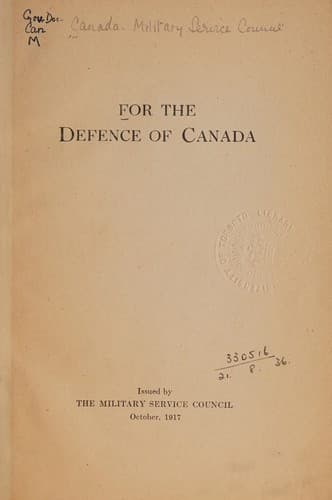
For the defence of CanadaCanada. Military Service Council
History
For the defence of Canada
Canada. Military Service Council
Canada -- Military policy; Draft -- Canada; World War, 1914-1918 -- Canada
FOR THE
DEFENCE OF CANADA
Issued by
THE MILITARY SERVICE COUNCIL
October, 1917
FOR THE DEFENCE OF CANADA
I.
There is no serious suggestion among British people that Great Britain
could have remained neutral in the Great War which broke across Europe
three years ago and which still fills the earth with devastation and
mourning. By British people one means not only those of English speech
and British origin, but all of any race or tongue or creed who salute
the flag, and enjoy the heritage of freedom which belongs to British
citizenship. The mother country had an understanding with France which
could not be ignored; an obligation to Belgium which could not be
repudiated without dishonor. In the conventions and understandings
to which the British Empire was committed there was no menace to any
other nation. The object was not to make war but to keep peace; not to
divide or convulse Europe but to assure international security and the
honorable and happy independence of all peoples.
II.
It is true that the British navy was maintained in strength, vigor and
efficiency, but the navy was not an instrument of aggression nor even
the guardian of exclusive paths for British commerce across the seas.
It was the bulwark of freedom; the police force of all nations. The
trade of the Empire had no other protection. The Empire itself had no
other wall of defence. There was no British army to challenge other
communities nor any thought of aggression or conquest. Indeed it is
certain that the people of Great Britain and the Dominions could not be
united in support of a war for territorial extension or a wanton attack
upon the independence of any other country. There may be doubtful
chapters in British history. There may have been ages when Great
Britain was willing to live by the sword; when her statesmen strove
for dominion over other lands and peoples. But with the Victorian
era a new spirit entered into British councils. Her statesmen thought
of the sword only as a necessary guarantee of British security. They
gave earnest support to all movements designed to settle international
differences by conciliation and arbitration. They were so “slow to
anger” that envious and restless neighbors persuaded themselves that
the old might and puissance of Imperial Britain had gone forever.
III.
Public-domain text, read in full here on John Shaqi.
Reviews
Reviews
No reviews yet
Be the first to share your thoughts on this work.
Join the Discussion
Join the discussion
Sign in to leave a comment or review.
Sign InorCreate an account