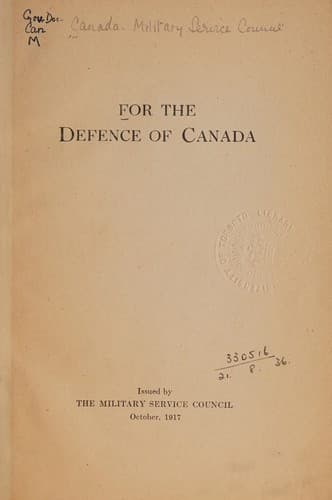
For the defence of CanadaCanada. Military Service Council
History
For the defence of Canada
Canada. Military Service Council
Canada -- Military policy; Draft -- Canada; World War, 1914-1918 -- Canada
In Canada as in Great Britain we enrolled a great army under the
voluntary system. If it had been said a few years ago that the Dominion
could secure 400,000 men for a war in Europe the statement would have
been treated with derision. But the fact that voluntary enlistment has
been so satisfactory is an argument for, not against, a compulsory
draft. The need for selection is more imperative. Such great sacrifices
demand our last effort to ensure that they shall not be in vain.
The magnitude of the enlistment emphasizes the danger and the vital
interest of Canada in the issue. It is admitted by the authorities
that in a few months all available reinforcements will be exhausted.
Appeal and persuasion have ceased to bring any considerable response,
although not wholly without effect. There is no prospect of peace
in the near future. We must, therefore, gradually withdraw from the
war as our regiments become ineffective fighting units or supply such
fresh troops as will meet the loss and wastage. There is no suggestion
that fresh troops should be withheld. Even those who oppose the draft
declare that adequate reinforcements must be provided. It may be
that compulsion would not have been applied in Canada if voluntary
recruiting could have been maintained, but with comparative failure
of voluntary recruiting and little prospect of revival it is curious
that the draft should be opposed if the necessity for reinforcements is
admitted.
XVIII.
In 1863 Lincoln prepared an opinion on the draft for the Civil War in
which he said, “At the beginning of the war, and ever since, a variety
of motives, pressing some in one direction and some in the other, would
be presented to the mind of each man physically fit for a soldier
upon the combined effect of which motives he would, or would not,
voluntarily enter the service. Among these motives would be patriotism,
political bias, ambition, personal courage, love of adventure, want
of employment and convenience or the opposites of some of these. We
already have, and have had in the service, substantially all that can
be obtained upon this voluntary weighing of motives. And yet we must
somehow obtain more or relinquish the original object of the contest,
together with all the blood and treasure already expended in the
effort to secure it. To meet this necessity the law for the draft has
been enacted. You who do not wish to be soldiers do not like the law.
This is natural, nor does it imply want of patriotism. Nothing can be
so just and necessary as to make us like it if it be disagreeable to
us. We are prone, too, to find false arguments with which to excuse
ourselves for opposing such disagreeable things. In this case, those
who desire the rebellion to succeed, and others who seek reward in
a different way, are very active in accommodating us with this class
of arguments.” He added, “The republican institutions and territorial
integrity of our country cannot be maintained without the further
Public-domain text, read in full here on John Shaqi.
Reviews
Reviews
No reviews yet
Be the first to share your thoughts on this work.
Join the Discussion
Join the discussion
Sign in to leave a comment or review.
Sign InorCreate an account