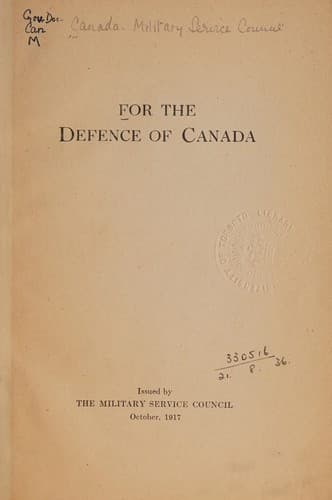
For the defence of CanadaCanada. Military Service Council
History
For the defence of Canada
Canada. Military Service Council
Canada -- Military policy; Draft -- Canada; World War, 1914-1918 -- Canada
Under national service “conscript” has no invidious meaning. It is
expunged from the language. As Lincoln said, failure to volunteer
does not necessarily imply want of patriotism. Who has the right to
judge his neighbor? Who fully understands his neighbor’s position?
If we think of our school days we will recall the boys who had a
natural instinct for fighting. We will think, too, of those who
shrank from rough physical encounters, and were almost suspected of
actual cowardice. But how often in emergencies those under suspicion
of cowardice revealed courage and daring at least equal to their
more pugnacious comrades. They would, perhaps, be the last to join a
volunteer fire brigade but, if occasion required, they would fight a
fire as courageously and resolutely as their adventurous associates.
The new regiments to go forward under the Military Service Act will
perform deeds of valor equal to any that have glorified Canadian arms.
There will be Military Crosses for many of those who found it hard to
decide between private and public duty. “I will give unto this last
even as unto thee.”
XXIII.
Under national service the State calls all its manhood to arms but
relieves from odium and suspicion all those who can better serve its
interests on the farms, in the factories, or in other necessary civil
activities. The Military Service Act of Canada, as has been said,
was passed by Parliament in obedience to a general public demand and
in assertion of the Government’s deliberate conviction that only by
selective draft could the necessary reinforcements for the army in
France be obtained and the orderly continuance of production and
industry assured. In the machinery for applying and enforcing the
measure there are ample safeguards against partiality, injustice
or partisanship. The Military Service Council has been constituted
to advise and assist in the administration and enforcement of the
Act. The Deputy Minister of Justice is the chairman of the Council,
and the other members have been chosen equally from the two great
political parties. The advice of the Council is sought in order to
ensure that the Act will be administered with just and equal regard to
the interests of all classes of the community, and in all questions
affecting the draft, requiring the consideration of the Governor
General or the Minister of Justice, the conclusions will be reached in
consultation with the Council. Moreover, the provincial registrars and
the local tribunals receive instructions from the Council as to the
manner in which their duties are to be discharged; and, while the local
tribunals exercise their judicial functions with perfect independence,
so far as concerns the determination of individual cases, they may
nevertheless refer to the Council for direction or advice upon general
questions of doubt or difficulty. Provincial tribunals, chosen from the
judiciary of the various provinces, are provided for resort by those
Public-domain text, read in full here on John Shaqi.
Reviews
Reviews
No reviews yet
Be the first to share your thoughts on this work.
Join the Discussion
Join the discussion
Sign in to leave a comment or review.
Sign InorCreate an account