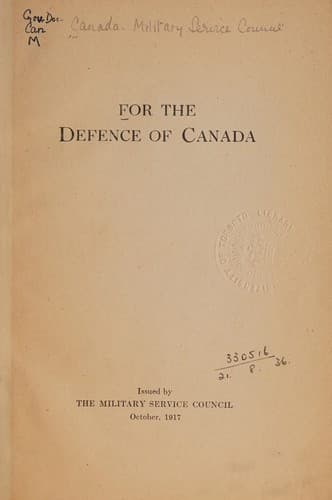
For the defence of CanadaCanada. Military Service Council
History
For the defence of Canada
Canada. Military Service Council
Canada -- Military policy; Draft -- Canada; World War, 1914-1918 -- Canada
It has been said that failure to volunteer does not necessarily imply
want of patriotism, but it will be hard to find any decent excuse for
men who neglect to register under the Military Service Act. There is
assurance of consideration for those in difficult circumstances. There
is certainty of exemption for adequate reasons. Failure, therefore,
to respond to the State’s appeal will imply want of patriotism and
expose the recalcitrants to compulsion in its ancient and more odious
significance. The Government cannot be partial towards individuals
or classes or communities. There is no provision for the purchase of
substitutes such as unfortunately occurs in the Canadian Militia Act of
1906, and which constituted a flagrant defect in the draft as applied
in the American Civil War. Rich and poor are on a common level. Equal
in citizenship, from all equal service and sacrifice are required. As
reinforcements are needed those who have been found liable and fit
for service will receive notice to report at the nearest mobilization
centre. Neglect of the summons will expose offenders to a maximum
sentence of five years’ imprisonment at hard labor. Nor will any
civil punishment relieve such offenders from the performance of their
military duties. All sentences will be imposed ordinarily by the civil
magistrates but in cases of refusal or wilful neglect to report for
duty the military authorities may inflict the severe penalties due to
deserters.
XXVIII.
A direct obligation rests upon employers to assist the registration
tribunals. They will fail in patriotism and public spirit unless
they encourage those in their service to enroll. They will fail as
surely if they demand exemption for employees of military age and
physical fitness who can be released without serious detriment to the
enterprises with which they are connected or who are connected with
enterprises of inconsiderable national significance. It is assumed that
in many cases applications for exemption will be made by employers
or by relatives rather than by those liable to military duty. The
evidence of employers that men are indispensable in their civil
occupations will generally be necessary to secure favorable judgment.
In Great Britain many employers furnished lists of those whom they
desired to retain and appeared on their behalf before the tribunals.
No doubt this will also be the general practice in Canada, although
the right of personal appeal must be regarded as proper and absolute.
There will be those whose circumstances peculiarly justify exemption
for whom no one else can appeal. While the great and immediate object
is to secure reinforcements for the expeditionary forces, selection
without injustice to individuals or unwise interference with essential
industries is the definite duty and obligation of the tribunals.
XXIX.
Public-domain text, read in full here on John Shaqi.
Reviews
Reviews
No reviews yet
Be the first to share your thoughts on this work.
Join the Discussion
Join the discussion
Sign in to leave a comment or review.
Sign InorCreate an account