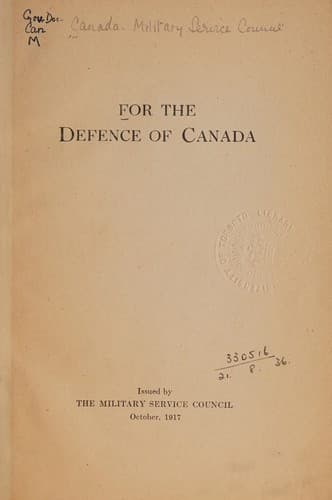
For the defence of CanadaCanada. Military Service Council
History
For the defence of Canada
Canada. Military Service Council
Canada -- Military policy; Draft -- Canada; World War, 1914-1918 -- Canada
The United States was in a position to profit by the experiences of
Britain and Canada. It had knowledge of the disadvantages of the
voluntary system as revealed in the British countries and freedom from
the illusions which delayed and embarrassed the original combatants. We
hardly yet realize what a revolution in opinion was necessary before
the draft could be applied in Britain or the United States. We have a
new revelation in democracy which would have come slowly, if at all,
if the war had gone more prosperously for the Allies. It would not
have come had the war ended in one or two campaigns. Sheer military
necessity chiefly explains the change in popular feeling. At least
in Britain and Canada the demand for compulsion became so general
and formidable that the Governments could not resist. Jean Jaures,
an extreme Socialist and idealist, argues that the rooted objection
to national service which has been so common in democratic countries
finds its support in the spirit of caste and the vested interests of a
class who cling to the idea of commanding a great army, segregated from
the nation in a world of its own, with its own laws, its own pomp and
circumstance, rather than of accepting their position as the leading
citizens in an armed nation. He insists that “just as there is no power
more majestic than that of the national will embodied in law, so there
is no army more powerful and more capable of endowing its leaders with
moral authority and prestige, if they are in harmony with it, than an
army which is the armed nation itself, inspired with the determination
to defend its independence and organized for the purpose.” Events
justify Jaures and go far to establish national service as the sound
and necessary military system for a democracy at war. The feeling that
the army necessarily constitutes a separate class is dying. So is the
idea that only those who choose to bear arms are responsible for the
national safety. Passing, too, is the notion which divides armies into
free men and “conscripts” and regards compulsory national service as
destructive of individual freedom and personal independence.
XIV.
Public-domain text, read in full here on John Shaqi.
Reviews
Reviews
No reviews yet
Be the first to share your thoughts on this work.
Join the Discussion
Join the discussion
Sign in to leave a comment or review.
Sign InorCreate an account